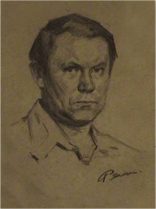
There is a joke: “Is it true that artists have an overly developed self-esteem? Oh, yes! Some even imagine that they are more talented than me.” For this reason, one should not be surprised if in these memories of mine, from time to time, something from this joke slips out.
Nothing can be done – like even the sages, who glorified the high title of man, I also descended from a monkey. True, not directly, but with a distance of many millennia.
In a word, the time came, and I went and was born. This significant event took place in the city of Taganrog, Rostov region, on May 17, 1926. To a large extent, I owed this to my father and mother. Dad was a carpenter, a Ukrainian. My distant ancestors were Zaporozhian Cossacks, my closer ancestors were serfs of General Raevsky. Dad himself, Ryasnyansky Alexey Mikhailovich, fought in Sievers’s cavalry. Mother – housewife Nikolaenko Anna Vasilievna, later – Ryasnyanska. I was already over 40 when I learned from my father that he was Ukrainian, and at my mother’s insistence I was registered as Russian.
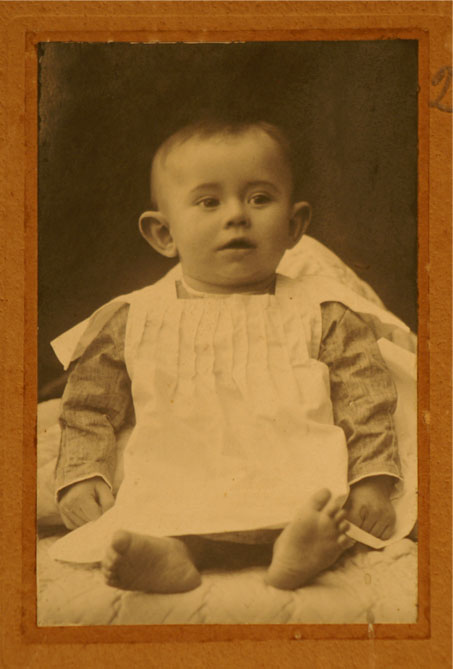
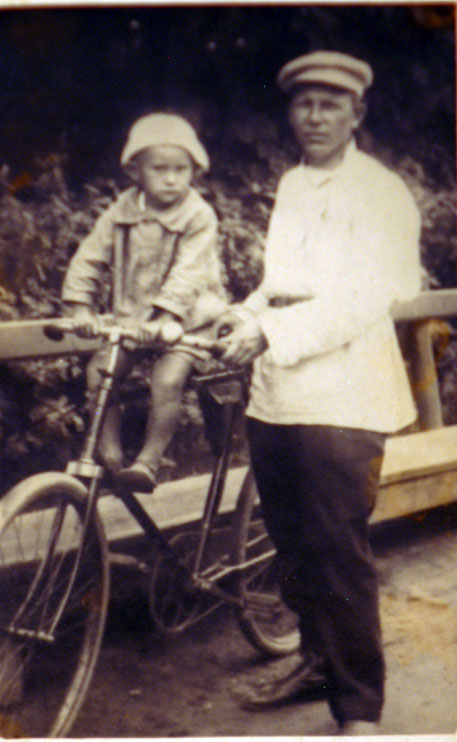
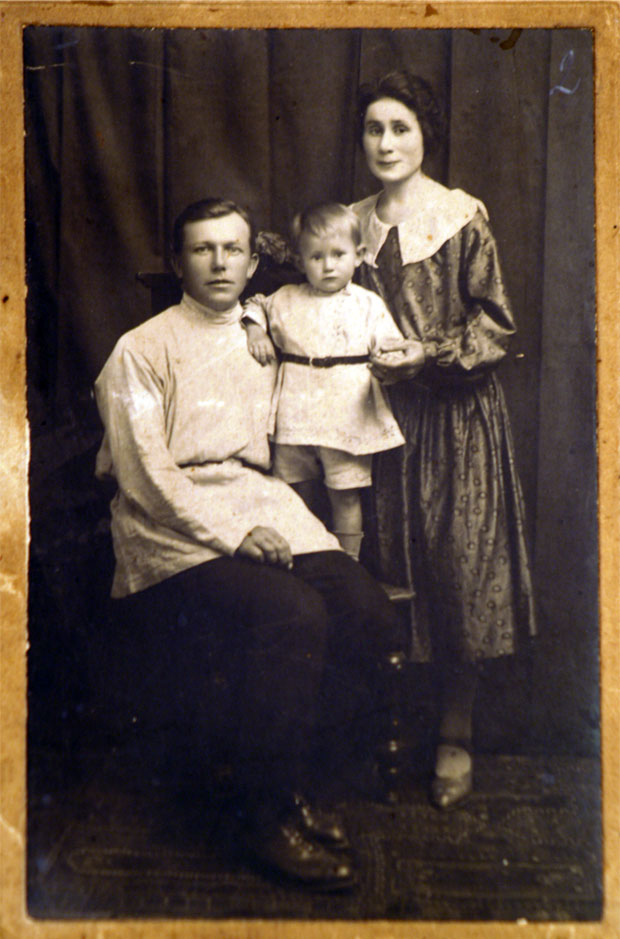
Well, I was born, nothing can be done – I have to live, which is what I still do, although, I admit, I am already pretty tired of it, but what can I do – I live.
My first memories are associated with kindergarten. I remember crawling on my belly and drawing something. And then I sat on a bench and read something to my colleagues. According to my parents, I started reading at 3 years old, which is why they decided that I would inevitably become an intelligent person – a natural misconception of most parents.
Some scraps of memories have survived – my dad and I went to the market and dad bought me an amazingly tasty pie. As soon as I started to eat it, some impudent bird took and dropped something on this pie. Naturally, I started bawling about this. I don’t remember exactly, but I think dad bought me another pie. I remember well how dad carried me from the kindergarten on his neck. Later this happened more than once and I always liked it. Over the years, I have come to the conclusion that people generally like to ride on someone’s neck; a rosy-cheeked baby and a big-faced official, both do it with pleasure. I also remember this well: when guests came, they would put me on a chair, I would shout something about a dying swan and desperately swing my head. This was called “reading poetry with expression.”
Art, artist. It never occurred to me that such a profession existed. At that time, there was no better artist for me than Uncle Efim, my mother’s brother. How he drew horses! Curly manes, red saddles, four legs and all with black hooves. No, there was no better artist in the world than Uncle Efim. And picture books? They simply existed, just like I, the trees, the dogs, the cabbies, the neighbors. Some people draw pictures, some print them: books existed and that’s it.
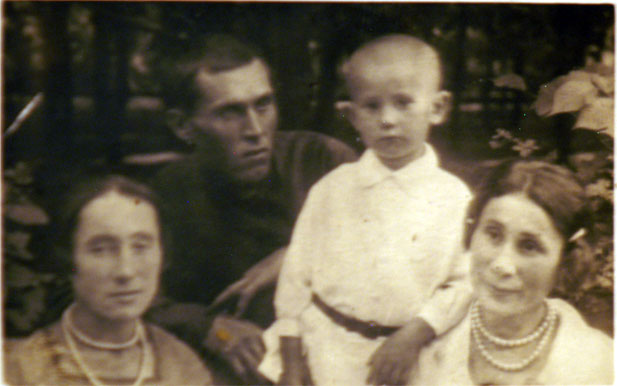
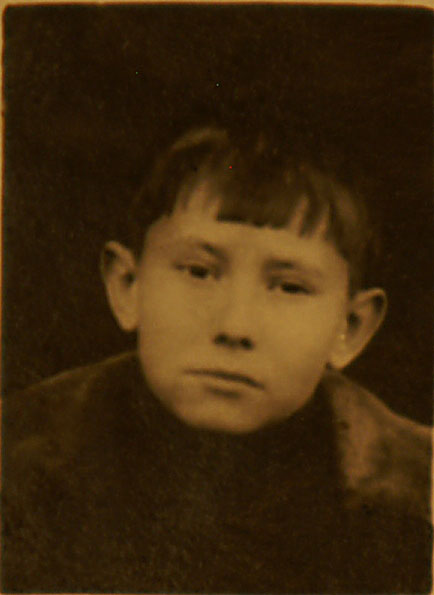
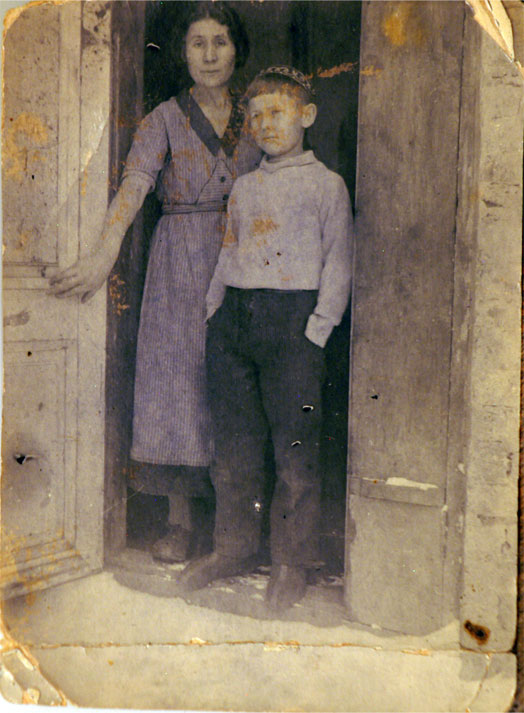
I don’t remember how I was taken to school, I don’t remember my first teachers either, but I remember the art club at the aircraft manufacturing plant club where my father worked very well. This club was very close to our apartment and I was very lucky that I started getting acquainted with art in this art club. The thing is that it was led by a person who was sincerely in love with art, and realistic art at that, and who tried to the best of his ability to pass on to us, the studio members, his, as I now understand, not so great knowledge. At that time, every word he said was a revelation to me. Over the years, I have learned a lot, understood, experienced in practice, but what I have now is based on what was laid down by my first and most important teacher – Sergei Alexandrovich Orlov, may he rest in peace.
The studio was located in a tiny room, no more than 15 square meters in size, and how 8-10 people could fit in it, I still can’t understand. There were no props necessary for training an artist. No plaster casts, no draperies, nothing. I remember I started learning to draw on embossed cardboard bas-reliefs on antique themes – various rosettes, griffins, gorgons, etc., that Sergei Alexandrovich brought from home.
There was even an anecdotal story, but with a dark undertone. The director decided to make a still life with a skull in it, because knowing and being able to draw a skull is necessary in order to confidently draw a living person later. Well, he shared his idea with us studio members. I was the only kid there, I was 8 or 10 years old, but everyone else was respectable, 17-20 years old. The guys were real enthusiasts and soon dragged in a skull and bones with some remains of meat that had not yet completely rotted. This still life was my first work, which I made with a mysterious and magical material – oil. To my great happiness, I have preserved this work. We mostly drew with pencil and painted with watercolors. I still remember with what prayerful delight I admired the new watercolors that my father bought me. I’m not even talking about oil paints! My parents were very poor and only over the years did I understand what it cost them to supply me with the necessary materials. Sometimes my father would bring a piece of Whatman paper from the factory, sometimes a piece of percale, which was used to cover something in an airplane. Percale was a ready-made primer for me.
I remember a funny incident. We had a studio member, Kostya Ivanov, much older than me, who was already working as an artist in a movie theater. Oh my God, how he painted still lives! He did it on a drawing notebook, the cheapest kind, where the paper had a surface like a honeycomb. I only saw how amazingly he did it. Oh, how I wanted to try this paper, I would show you! So, having plucked up my courage, I once offered him a rather large piece of Whatman paper in exchange for a sheet of paper from his notebook. To my surprise, he agreed. Alas, nothing worthwhile came of it. Apparently, materials are not everything. Skill is also necessary.
Time was passing, and I started to get something. I had a reputation as an artist in our yard, and one day a neighbor gave me a file of the Niva magazine for 1915 to look at. It was another shock. What drawings there were by Samokish, Avilov, and other brilliant battle painters! Impressed, I started to make something that seemed to me to be my own. True, I did not do direct copying.
Of course, I had dashing Red Army soldiers, who were cutting down all the enemies in an unknown uniform, an unknown army. I also had battles at Lake Khasan. Here it had an effect that the son of another neighbor was a commander in the Red Army and participated in battles there. I don’t know who and how sent my drawings to Moscow, but at the all-Union amateur competition of the aircraft builders’ trade union, where adult uncles and aunts participated, I was awarded the first prize. They forked out 150 rubles. In those days, that was a lot of money.
My parents decided to buy me a suit, but I was stubborn, I wanted a camera. The thing is that the son of the neighbor with the magazine “Niva” was into photography and I caught this bacillus from him. I don’t remember whether they bought me a suit or not, but I cried for the camera. Dad bought me an old “Fotokor” camera on glass plates, with an expandable, accordion-like body. For a while I even forgot about drawing. Of course, to draw you have to mess around a lot, and it doesn’t always work out, and here I snapped a few shots, developed them, and it was done.
Then I went back to drawing and suddenly – shock – the art club was closed. I don’t know what the management was guided by. The first week at the all-Union competition should have seemingly cemented the status of the art club, but at the same time drawing is drawing, and childhood is childhood.
Around this time, the movie “Chapayev” was a resounding success. All the boys in the USSR went crazy. In our yard, I was Chapayev. Not at all because I had some kind of military leadership talent or even ****. Everything was much simpler, my dad made me a machine gun, just like a real one: a shield and wheels, and even a ratchet, so I didn’t have to yell tra-ta-ta-ta. This was an indisputable argument in favor of the fact that Chapaev had to be only me and no one else. Sometimes, however, I graciously agreed to be Petka, but not lower. Oh, what a sweet war it was and how different from the one I had to get to know a few years later.
And yet, despite “Chapaev” and my passion for photography, the artist that had accumulated in my soul did not give me peace. Once my native studio was closed, I had to go to another one, at the city Palace of Pioneers. Alas, it was not the same. Instead of a careful, loving depiction of nature, there was a kind of freedom of creativity. I don’t know, maybe it was good, but by that time I had already formed my own attitude to art, to working from life, and disregard for real truth was unacceptable to me.
I remember a funny episode. Once the art club of the Palace of Pioneers went out into nature. Everyone settled down here and there. After working a little, I wanted to see how everyone was painting. I went. I looked. I was coming back, and there is a goat standing next to my sketchbook, looking critically at my sketch and chewing a tube of strontium yellow. At first I was confused, then indignant, and she snorted contemptuously and proudly walked away with the tube in her teeth. It was useless to take it away.
School. Well, everything was fine for me here. I studied easily. However, maybe it was because I drew wall newspapers and they simply gave me inflated grades. I can’t judge this now, but as for the exact sciences – mathematics, physics, I’m afraid that’s exactly how it was.
I will never forget my teacher of Russian language and literature Zinaida Anatolyevna Levitskaya, a teacher by the grace of God. She never shouted, never showed that she was angry with us, and we never gave her any reason for it. There was perfect silence in her lessons. We sat with our mouths open and listened to her reading. How she read! Once she read Lermontov’s “Mtsyri” to us in one fell swoop. After that, even the most inveterate blockhead could not help but love Lermontov.
Friends. Of course, there were friends, there were enemies. I beat some, some beat me – everything as it should be with boys. Of all my friends and acquaintances, I would still single out Zhenya Radionov. He was three years older than me, an intellectual, a smart guy, an enthusiastic local historian, a member of the local history circle at the local history museum, and he got me interested in that too. He also drew and wrote poetry. I can’t judge the level of his poetry now, but at that time they seemed wonderful to me. He introduced me to the poetry of Mayakovsky, whom I had not perceived at all before. He had no father. He was the only son of his mother, and his mother was disabled without legs. Zhenya died in the WWII, an offensive, absurd death. Lieutenant Radionov was chasing a deserter and drowned in the river, I don’t know, but it seems to me that if he had survived, he would have been the pride of at least Taganrog. After I had finished my war, I went to see Zhenya’s mother on crutches. She told me about Zhenya’s death. She gave me Zhenya’s watercolors. But I rarely, oh how rarely, did I go to see her. Yes, I studied in Rostov, but I still can’t forgive myself for that. After all, as I now understand, I was a part of her son. There were many things in my life that I am ashamed to remember. This is one of the most, most. After the end of the war, Zhenya’s mother did not live long.
I don’t know what my parents were guided by, but after seven years of school, which I graduated with honors, I was sent to an aircraft construction technical college, although I dreamed of an art college.
It sounds crazy, but the war saved me.
I had no doubt that our Red Army would quickly smash the fascists to smithereens. The news from the front was becoming more and more terrible. Now even the newspapers often talk about battles near Moscow. Here are the Germans in Taganrog. My father evacuated with the factory, leaving me and my mother a sack of half-burnt wheat, which he managed to carry away from the grain elevator that was set on fire near the port.
A difficult and humiliating time began. How much the training I received in the art circle helped me out. Sometimes German soldiers would come, some with a loaf of bread, some with a piece of butter – I would draw their portraits for them, sometimes from life, sometimes from a photograph. Then, on the recommendation of my good pre-war friend Vasily Mitrofanovich Bazilevich, who worked in the local history museum, which was also an art gallery (an excellent one, by the way), I was accepted to work in this museum, for which a mysterious position was invented – artist-intern. Vasily Mitrofanovich was a very educated, erudite person, an excellent connoisseur of literature, fluent in German, English and French, and had an excellent library. He introduced me to the poetry of Alexei Konstantinovich Tolstoy, which I fell in love with for the rest of my life. As I guessed, he was a Jew, which was later tragically confirmed by his unexpected disappearance. At the same time, a certain Davidovich was in charge of city culture; I don’t know his name or patronymic, and I haven’t heard of anything happening to him under the Germans.
Soon after me, my mother was accepted into the museum.
It is very possible that thanks to the museum I was not driven off to Germany. On the German side, Sonderführer Lebert was the patron of culture. I do not know on whose initiative the exhibition of local artists was organized in the museum. I also gave two conscientiously painted from life urban motifs. In one of them, without any political considerations, I depicted a plaster equestrian statue of Kozlovsky Ruslan and Chernomor standing near the city garden. Oh my God, how Lebert shouted about this harmless sketch! He saw a hint in it. I managed to calm him down only when I said – there is this sculpture near the park, go and have a look.
Somewhere around this time, his mother brought this “ugly duckling” to me, as to some kind of “maestro”, so that I would introduce him to high art. His name was Kolya But. Later he became one of the brightest, if not the brightest artist of the Grekov studio. Stalingrad panorama, Dnepropetrovsk diorama, a series of paintings dedicated to Adzhimushkay, Brest Fortress and many, many other paintings and portraits related to the Soviet era, at a very high professional level, where playing the first violin, where soloing, created Lieutenant Colonel People’s Artist of the RSFSR Nikolai Yakovlevich But. And Kolya got his first acquaintance with art from me. Then he was a puny boy with a thin neck and some kind of whitish fluff on his head. Could you imagine that later he would grow into a giant of almost one meter ninety with a deafening bass, very decisive and proactive.
Somewhere around this time I managed to help my Uncle Efim escape from captivity. I don’t know the backstory (I was just a boy), but Aunt Katya, my mother’s and Uncle Efim’s sister, took me to the commandant of the prisoner of war camp and I drew his portrait in pencil. His face was brutal, cannibalistic. No matter how hard I tried to soften it, the habit of drawing definitely got the better of me and I drew him with horror as he was. Oddly enough, he liked it.
Soon my uncle was released.
Everything comes to an end. The occupation came to an end. By that time I was 17 years old. I was drafted into the army and sent to a school for junior commanders.
We were walking to the front and along the way they explained to us that the bullet flies out of this end of the rifle, and this end is pressed to the shoulder, it is important not to mix them up. Maybe they would have explained more, but “buyers” showed up – who wants to fight in the guards unit? I went out among the others, and soon – to the front.
I did not become a hero. I did not take prisoner even the most worthless field marshal, I did not shield an embrasure with my chest; I ran somewhere, shot somewhere along with everyone else. It happened that I ran, but did not shoot, because I took apart the bolt of the rifle, but could not put it back together and it was jingling in my pocket.
By all logic, I should have been killed. If this did not happen, then probably because I looked very menacing. Well, and then, one day, something exploded nearby. A serious wound, a concussion. I came to – my legs did not obey. I was left with a feeling of terrible fatigue and expectation of death from the front.
I lay in the hospital for 7 months. This was in Orenburg. There they put me in order a little, taught me to move on crutches and persuaded me to stay there, with them. The reason is simple – I was busy drawing wall newspapers, posters, etc., etc. That is, I was not just sick, but a useful person in my own way. I still left – I really wanted to see my father, who worked at the plant evacuated to Tbilisi. Only there, at my father’s, in his dormitory, did the hole in my back measuring 28×11 cm finally heal. Then I turned 18.
In Tbilisi, I was once again convinced of what a useful profession I had chosen for myself. Soon after I came to my father, I was robbed. My father did not have the opportunity to take care of me during the day – he worked and advised me to travel by tram more often, to see the city better. I must say, there was a lot to see, and then, there was a crush in the tram, they pushed me from behind, I could not stand on my crutches, I fell. When I got up, it turned out that they had taken my wallet with documents and as much as 30 rubles from my pocket. I wasn’t even registered with my father yet. This is where my profession came in handy again. My father brought a photo of a local policeman and I drew a portrait from it. Soon all the problems were solved.
Then a note arrived with an invitation to come to some office, where they gave me my documents that they had found. I lived with my father for about two months and although it was clear how happy he was to see me, how he cared about me, I also felt how difficult it was for him to be with me. The dormitory was a simple barracks. There were four more people in the room where we lived; and the attitude towards us, Russians, was not the best, too many of us had arrived along with the workers and all sorts of scum.
In a word, I decided to return to Taganrog. This time the road was a nightmare. I was assigned an escort from the hospital in Tbilisi, who took on all the troublesome part. True, later, when she handed me over to my father and left, it turned out that she had stolen my food certificate with the monthly rations I was entitled to.
I made my way to Taganrog myself, on crutches, with disobedient legs. It was wartime – the trains were packed. Be that as it may, I got there. At the end of autumn (this was 1944) the Rostov Art College reopened. Here no one put any obstacles in my way.
I was accepted to the 2nd year. At first I lived right in college. After classes I put something under myself, wrapped myself in something. That was enough. Well, my studies, I would say, went on by themselves, without pedagogical intervention, if not for Captain Borshchev, a former theater artist, who somehow ended up within the walls of the college. He also spent the night at the college and I cannot remember if he taught anything. They said that he was simply hiding from the war. What really happened, I don’t know. So this Borshchev (I have unfortunately forgotten his first and middle names) spent a lot of time with me, explaining and showing how the composition of a painting is built. From him I learned that a painting is not an element, everything in it is subject to certain laws, thanks to which it acquires expressiveness. He somehow imperceptibly disappeared to an unknown location. Then there were rumors that he appeared in Simferopol, already under the name Borsayev. Whoever he really was, it is not for me to judge, but what I know about the composition of the painting, I got mostly from him.
Then I had to look for an apartment, and by the end of my studies, they gave a dormitory at the college and I lived there, in one huge room, where there were 12 or 15 beds. All the time I was working hard on my legs, trying to walk more and especially squat, and by the end of the studying I could move not on crutches, but with a stick. Well, and later I got rid of the stick, began to run and even tried to box.
I jumped a little in time. Somewhere after the 3rd year of the school, I and my fellow countrymen – Taganrog residents N. But and E. Dzerzhinsky, who also studied at the college, but in the year below me, went on an adventure – with fake copies of the school-leaving certificate we went to enroll in the Kharkov Art Institute. Naturally, we were riding on the roof of the train car – it was a normal, almost legal way for students to travel. When we got to the institute, they were defending their diplomas. I remember Slipchenko’s powerful painting “The Funeral of Taras Shevchenko in Kanev”. It left an impression on me for life. I was also shocked by the huge number of magnificent sketches for it. I don’t know the fate of this painting. It’s a shame if it perished. I don’t know the fate of the artist either. I saw graphics signed by Slipchenko at exhibitions. Could it really be him? The level was far from that.
And what about us? All three of us successfully passed the exams. I shared first place with a very gifted guy, a hunchback. I heard that he drowned soon after. I passed all my general education subjects with flying colors. It would have seemed like a good time to study, but someone started a rumor that there was a case at the institute when a guy with forged documents was not only kicked out, but also brought to court. I shuddered.
Maybe I would have stayed, but a very offensive incident happened. I was riding in a packed tram. A person on crutches was a common occurrence then, and not only did no one give up their seat, but everyone kept pushing and pushing until they pushed me out of the tram. I tried to get on the tram again, but out of nowhere a policeman came: “You’re trying to get in from the front platform.” He didn’t listen to any of my explanations and took all the money I had, very little – a fine.
This was the decisive factor. I took my documents from the institute, climbed onto the roof of the train and went home. The others stayed. Then they had to take entrance exams, but everything worked out. Both became famous artists, and But, as I already wrote, became a People’s Artist of the RSFSR, one of the leading artists of the Grekov Studio.
Only over the years did I understand what truly heroic efforts my parents made so that I could study. I remember how I arrived one evening (naturally, on the roof), walked in, and my father was sitting at the table without a shirt. He was a skeleton covered with skin, although he was naturally inclined to be plump. Now, when my parents are gone, when I can no longer do anything for them, I am often tormented by these memories.
With all the hunger and unsettledness in life, what a craving for culture there was! Popular music was not a mockery of the eardrums, from which there is now no escape anywhere, but the highest examples of classical vocals. Beniamino Gigli, Tito Schipa, Jan Kiepura, Tito Ruffo and other giants like them did not leave the movie screens. Classics were a normal, everyday phenomenon. Heartbreaking screams or hoarse muttering, hostile to the very concept of music, such as a voiceless girl singing with her back, as is now the norm, simply did not exist.
I remember a funny and in its own way even touching incident: one night I arrived in my Taganrog (naturally on the roof), knocking my crutches along the deserted street, and towards me – a person. An unknown force tosses his dear from a pole to a fence, from a fence to a tree. He moves along this intricate trajectory and screams. But what is he screaming about! Cavaradossi’s aria from “Tosca”: – “My time has come and here I am dying.” Of course, it has little in common with Puccini, but the fact itself! That is, the classics were the most everyday phenomenon, the norm. Just as now the norm is black stuff, pornography, bad taste, kitsch.
So, after my triumphant defeat in Kharkov, I returned home, in this case to Rostov to college. By this time, pre-war students had returned to the college, among them were strong masters, each of whom must be told about.
Zhora Solonin – a unique painter and an original, unique graphic artist. After college, he went somewhere to study further and disappeared, in any case, I never heard anything about him again. He was already an established artist with his own face. His painting was distinguished by amazing materiality with a sharp stylization of figures, objects, and landscape. I can’t find any analogues in art. Perhaps slightly, not so much in style as in expressiveness, it reminded me of Deineka. And the graphics – generally something unexpected, unlike anything else. Small black and white ink drawings of urban motifs. Yes, it was Rostov, but some kind of enigmatic, mysterious, mainly nocturnal. That is, the city seen not just through the eyes of a passerby, but through the poetic soul of a talented artist. He was awarded a personal exhibition and a regional prize from the Union of Artists while still a student at the Rostov Art College. Absolutely deserved.
Vladimir Tokarev is a confident, bright and fresh painter, for whom gray colors sounded like music. Later, after graduating from the Leningrad Academy of Arts, he became one of the most respected painters of Leningrad, and even later, the permanent artistic director of the creative base of the Union of Artists of the RSFSR “Academic Dachas”, for many years.
Arseny Chernyshov, who did not draw very accurately, but was a wonderful painter. His creative style was reminiscent of I. Repin
A. Romanichev, later People’s Artist of the RSFSR, professor at the Leningrad Academy of Arts.
And finally, Gennady Batov is a brilliant draftsman. I don’t know about now, but back then, if they showed me a drawing by Batov and didn’t tell me whose, I would have said Valentin Serov.
With their appearance at the college, I ceased to be a star of the first magnitude, and even received a B for my diploma work. By the way, I must say – deservedly so. In my diploma work, except for a rough miscalculation in the drawing of the central figure, I did not decide and, therefore, did not achieve a painterly state of the canvas. True, there was no offense. I repeat, I already then recognized the assessment as fair.
I remember a funny moment from my student life. Once I took and leaned the palette against my unsuccessful work, and then turned it 2-3 more times, after which I suggested that those who wanted to do with this canvas in turn do whatever came into their heads. In the end, the painting by the artist Bartacaccio “Night in Venice” turned out. Why Bartacaccio? – Batov, Ryasnyansky, Tatarchenko, Chernyshov. The guys later pushed this “masterpiece” through a second-hand shop.
Right after defending their diplomas, my classmates grabbed a big “hack job” – to design the central market in Rostov. The deadlines were insanely tight. Since I have never been on good terms with fonts, I was assigned dry brush portraits. I am still amazed how, on the eve of the project’s delivery, I managed to rub out 15 portraits of Politburo members in one night, including a color portrait of Generalissimo Stalin. Then I received money that I had never even dreamed of – a whole 5,000 rubles. I finally bought myself a very decent suit, coat, shoes, hat and lived for this money until late autumn.
I received the money and went to take exams in Leningrad, to the Academy of Arts. It is impossible to describe the shock I experienced from getting to know Leningrad, the Academy and its museum, the Hermitage, the Russian Museum.
Tokarev and I were applying from Rostov. Although at that time I could not walk for long without a stick, I mobilized myself to the utmost and worked so hard that other applicants crowded behind me. I even allowed myself to do not only my assigned task in painting – a head, but also a similar task for another group of exam takers. The painting task was a nude figure and a head, and I did 2 heads, in drawing – a nude figure and a head – A’s. I got a B in composition. After the exams in our specialty, our works were displayed in the corridor and the president of the Academy of Arts Alexander Gerasimov headed the commission. He marked with chalk the works of everyone admitted to take general education subjects. I passed them with A’s. Then the lists of those accepted to the Academy were posted. I was looking – my name is not there. I was looking again – it was not there. I run here and there, I find out: – my grades have all been reduced by one point. What’s the matter? It turns out that when I wrote my autobiography, just in case, I wrote vaguely about “was, was not during the occupation”, and then, when they handed out questionnaires where it was clearly printed: was during the occupation – was not, I had to write was. That’s where they dealt with me. Neither the fact that I fought as a kid, nor the disability, nor the fact that I had nothing to do with the surrender of Taganrog to the Germans worked. I was and that’s it – the Academy is closed to me. I don’t know how it turned out for Volodya Tokarev. He was a prisoner. He ended up in Stalingrad. Prisoners were not welcomed then either.Of course, I didn’t pry, and I still don’t know. It was a terrible shock for me.
I returned to Rostov, got a job at the art fund, first as a designer, but even there I didn’t do fonts or actual design work, but made various necessary paintings, then I transferred to the painting workshop. There I already felt at home. Participated in exhibitions. In my youth and stupidity I wasted a lot of time senselessly, I don’t know where. One artist, unfortunately I forgot his name, Honored Artist of the Kabardino-Balkarian ASSR, introduced me to the basics of etching and under his guidance I made a couple of sheets, one of them “portrait of A. Pushkin against the background of the “Bronze Horseman” was at an exhibition. That, if you don’t count a few books, was the end of my relationship with graphics.
Somewhere around 1949 I suffered through a rather bad picture “Planting a Forest Belt”, in the worst traditions of socialist realism. I do not want to spit on all of socialist realism, which gave the world many genuine masterpieces, truly great art. But it also had cliches and hackneyed plots, routine poses with proudly raised heads, etc., etc. So in that picture of mine I used all the worst that was in it. Just like the “fragrant” stamped “avant-garde” is now.
By this time I had already gotten rid of the stick and started running, at first it looked pretty funny. However, I persisted and gradually forgot about the injury, the concussion. When the time came for the next medical commission for disability, I brought a statement that I was already quite healthy and did not consider myself disabled. Of course, I was crossed out from the disabled without any discussion. I tried to do boxing, this is my long-standing passion. Alas, I did not become a boxer. I am too slow for boxing.
Got married. Got married stupidly, without love. I convinced myself that I loved, but there was no love. I only ruined the life of a good man. Life became boring, depressing. I worked a lot for the sake of earning money. I illustrated a couple of books, although I did not feel like a graphic artist. The worst thing was that I had to write titles, and the Lord God himself forbade me to do this. To paint pictures for exhibitions – subjects did not come to mind, and if something did come, it was so hackneyed, so written and rewritten, that it was disgusting to develop it myself. I did not develop it.
The pain left over from entering the Academy had subsided by that time and I decided to try to enter the Kyiv Art Institute. The arguments in favor of this institute were very high: “Khleb” by Yablonskaya, “Chernomortsy” by Puzyrkov, more than convincingly spoke about the level of this institute. Zhenya (the more time goes by, the more I am convinced what a good wife she was) did not object and I made another attempt. This time in my application I directly, even emphatically wrote that I had been during the occupation. I was admitted to the exams. Again I pulled myself together, mobilized my will, again there were applicants standing behind me. And again I got all A’s and one B, I don’t remember what the B was for. But not in composition, as before in Kharkov and Leningrad. The thing is that in Kyiv I simply repeated my painting, painted and participated in the exhibition in Rostov. This time I was on the list of those accepted. The first. For the sake of fairness, I must say that by the time I entered the institute I was a candidate for membership in the Union of Artists and I was even allocated a studio in Rostov. I still wonder – did I need the institute? Over the years, having painted more than one picture, I came to the conclusion that a picture, starting from the concept, the search for a solution to the composition to the psychological accuracy of the images, gives more than a course of study at the institute. There is a difference, and not in favor of the institute, whether to draw with great diligence, but completely meaninglessly a model or to draw a model for a picture, knowing why you are drawing him, what you want, what you are trying to achieve from this drawing, what kind of expressiveness. To draw more than once or twice, until you feel that you have finally achieved what you need. I came to this conclusion over the years, and then I was happy.
The first year I lived in a hostel, in a friendly, cheerful student company. Since there was no boxing section at the institute, I went to gymnastics. The head of the physical education department, Khannon Grigorievich Berman, immediately believed in my athletic nature (and by that time I was already in good athletic shape) and immediately went to the city skiing competitions. None of my assurances that I had never skied were accepted. There were 2 or 3 days left before the competition and I started to master skiing, running around the institute, but what can you master in 2-3 days?
So, the competition. They were held in the Goloseevsky forest near Kiev. I will not describe how many times and how I fell, but there were more than enough opportunities for this – steep climbs and descents, the most rugged terrain. It ended with a stubborn fight with my classmate Naum Dollar, with whom we fought according to the principle: either he falls, then I rest, or I fall, then he rests. He took the last place from me. When we dragged ourselves to the finish line, there was no one there anymore. Berman was standing there, completely blue, and his teeth were chattering so much that he could not even curse us. With gymnastics, things were fine. I didn’t take first place, but I consistently brought the team the necessary points.
I remember how we celebrated the New Year. Naturally, we drank too much. Tall Kolya Popov (now a professor at the Kyiv Academy of Arts – Nikolai Tarasovich Popov) either drank too much or was tired, but he lay down and fell asleep. In the dormitory there were two or three wardrobes in a row. We took him and his bed and put him on these wardrobes, after which we went for a walk. It was already far, far past midnight. There was a movie theater near the institute, a New Year’s tree near the movie theater, and a policeman near the tree. Frozen, frozen. We walked and walked, then suddenly grabbed the policeman by the hands and began to dance around the tree to cannibalistic screams. We parted as friends. We returned to the dormitory, went to bed and suddenly from above a bass voice “What have you parasites done!” – Kolya woke up. Good thing he didn’t fall.
We were unlucky with our studies in the first year. Our teacher was Professor Sergey Nikolaevich Erzhikovsky, a good, kind man, but absolutely incapable of teaching anything. This is not surprising – he himself did not know how to do anything. It would be better if he didn’t advise anything, but he gave such advice, whether you stand still or fall. One day he decided to correct the work of Kolya Storozhenko (now Professor of the Kyiv Academy of Arts Storozhenko Nikolay Andreevich), a brilliant painter, a subtle color artist, my main competitor at that time. He sat down in front of Kolya’s work and began to paint. Kolya stood, looked, then suddenly ran out of the studio and did not appear until the end of the lesson. The professor looked around in surprise, sighed and also left. He gave me absolutely “brilliant” advice on composition, which, whether you like it or not, I had to take into account, because not to take into account was simply dangerous. I made a sketch: in a village store, a man is buing an accordion and trying it out – an ordinary everyday scene. So the professor began to insistently advise that instead of an accordion, a portrait of Comrade Stalin should be bought and those present in the store should not listen to the accordion, but, imbued with high consciousness, look at this portrait. The result was an absurd, clownish caricature. Try to refuse – the institute had an all-powerful department of Marxism-Leninism. In the best case, I would have been kicked out of the institute. In painting, it was not painting that was done, i.e. work with color, tone, but blind copying of the surface of objects, and since the entire first year was the human head, then folds of skin, all sorts of cracks, etc.
Alas, not only in the first year, but also later, when we studied with such giants as Yablonskaya, and then Grigoriev, I do not remember that there was ever a discussion of tone, color, pictorial environment, i.e. about what painting actually is. We were making people and their surroundings with extreme precision of detail using oil paints.
At the end of the first year, I rebelled, as I thought. They assigned me a model – an old man who had three hairs on his bald head. And I went wild: having carefully drawn, I began by carefully depicting a piece of the background and these three hairs on a clean canvas, on which there was only a drawing, and then I began to slowly add the rest of the forehead, face, clothes, until I covered the entire canvas in this way. When I covered everything, it was ready. I did this and waited for the rout. They gave me an A, although I was consciously, deliberately doing anti-painting.
Then, in my first year, I noticed a devilishly talented girl who somehow didn’t get into the institute by competition and was accepted as a candidate. At first, I even helped her cope with her academic assignments-productions. What a powerful creative imagination she had. Her name was Ada Rybachuk. In her second year, she was already a full-fledged student, and later she shone in natural productions and no longer needed my help.
After the 1st and 2nd years, we did our summer practice near Kanev, very close to the burial place of Taras Shevchenko. The institute had a base – a large barracks, where we spent the night and where there was a canteen. Our professor Erzhikovsky was put in charge of the summer practice. By that time he had become so annoying to us that we established a watch, and when our next guard saw the professor coming up to our barracks, he would let us know and we would jump out the doors and windows from the other side. By the time the professor was entering, there was no one left in the barracks. We were watching from the bushes behind the sports ground for him to leave. Our professor was standing there, was looking around, was sighing and was leaving. Then we would show up.
One way or another, we had to do training productions and, willy-nilly, we couldn’t completely avoid contact with the professor. The so-called long landscape drawing really bothered us. No one explained to us how to do it, and to be honest, I still don’t know how to do it and we tried our best to avoid it. True, there was a nice guy among us, Pasha Skorubsky, who was held up as an example to us. In the morning Berman would send us out to do our morning exercises, and at that time Pasha would walk sedately past us with a large folder, and no one would dare to stop him – Pasha was going to do a long drawing. This continued until one day, while walking through the forest after our exercises, Berman became interested in some strange growling. He stopped, then quietly approached. Pasha Skorubsky was snoring in the bushes, putting the folder under his head – finishing his morning sleep.
I must admit, I was completely helpless in the landscape. Well, I just didn’t know how to approach it. By the way, this had been going on for many years, and even when I brought more than a hundred sketches from fishermen in Vilkovo from my summer practice after my third year, I was still afraid of landscape. The thing is, I just didn’t know how to paint it. The habit I had acquired at the institute of counting all the grass and bushes instead of painting the play of light and color that create the image had an effect. I only came to this truth many years later, and I came to it myself.
In my second year, Tatyana Nilovna Yablonskaya was already teaching us. Of course, we were delighted with her, although, to be honest, with her as an artist. She was then in the prime of her life and skill. We saw her “Spring” right on the easel (children on the spring asphalt playing with various bugs and spiders). It was a shock! It’s a pity that such an incredible talent fell under the influence of people with little talent. And Tatyana Nilovna began to paint like everyone else, well, maybe a little better, but not like that, not like that. As for teaching, I simply don’t remember how and what Yablonskaya taught us. It seems like nothing and in no way, but the consciousness that we were students of a great master was inspiring.
At the same time, I don’t remember whether it was my second or third year, I got my only C. Sergei Alekseevich Grigoriev came to see us, he had become the director of the institute by that time, replacing Sharonov in this post, and he started telling us about the art of drawing. Grigoriev was a unique storyteller. He expressed the idea that we should copy drawings, say, by Rembrandt, his drawing technique, how he handled the strokes, the line. Having listened enough, I went to the institute library and devoted several evenings to copying Rembrandt’s etchings. After I had acquired too much science, I applied it in a study assignment and got a C. Conclusion – it’s not about technique.
I think I was in my second year when my wife agreed to move to the Kyiv region. We rented a room in Boyarka. Electric trains ran frequently, and I almost never used the tram. In the evening, after training, I usually ran to the station, enjoying it.
Then, I think I was in my third year then, Gennady Batov entered the institute. Alas, at that time he was already drinking heavily and although he was a brilliant draftsman, he drew much less often and his skill was declining. He was also married by that time and also settled in Boyarka. Batov is short, frail, but very quarrelsome. For this reason, he did not study at the institute for long – he started a fight with someone, being very drunk, and he was expelled from the institute. At first, he came to me more and more often, and then he even moved into my room. My wife didn’t like it at all, and I must admit, neither did I, but a friend is a friend and I didn’t show my displeasure.
Well, my studies were going their own way. I realized that I couldn’t keep up with the background drawing specialists and began to draw in my own way. In my drawings, I strove not for accuracy, but for expressiveness. The teachers began to get used to this and A’s became my standard grade. But in general, I still remember with quiet delight, like a circus trick, those fabulous, mind-boggling backgrounds that Kolya Popov and especially Kolya Polischuk, who even received the nickname Background Polischuk, made. I don’t remember the drawings themselves, but the background!!!
Financially, I lived well for a student. In my first year, I received an increased stipend, and then a personal stipend, the Repin stipend, which was enough for food, for two with my wife, and for rent. I also earned extra money in the workshop at the institute, which accepted orders that were carried out by students. The workshop was headed by Mikhail Belsky. Later, he became a People’s Artist of Ukraine, and before him, I remember Chernikov.
I recall a funny episode (for us, from the outside, it was funny, but not for the participants), when rumors began to circulate: Professor Trokhimenko and Chernikov were preparing a painting for the Stalin Prize. The times were such that if there was Stalin and a lot of people in the painting, and the painting was large in size, then the Stalin Prize was a very real prospect. I don’t remember where and how, but it seems that in the assembly hall we managed to stealthily catch a glimpse of this painting – “Stalin at some congress”. We had a very sad impression. Later, I saw something more boring and helpless only in the works of the “remarkable” Soviet artist Ilya Glazunov, a brilliant master of elbow work. Nevertheless, the prize was approaching and was ready to become a reality, but none other than Joseph Vissarionovich himself let them down – he suddenly died. The epochal work remained unclaimed. But in general, Stalin’s death was perceived by the people as a tragedy. On this occasion, I published completely serious, sincere poems in the institute wall newspaper, the first serious ones in my life. Before that, I made rhymed captions for other people’s caricatures. I myself was convinced that I would never master caricature. The captions turned out to be very spiteful. I have forgotten almost all of them, I only remember a fragment about how it was very cold in the dormitory in winter and even a carafe of water burst:
“Father Frost himself came in, stamped his foot,
The carafe of water burst because of cold.
The authorities, apparently, never came here,
like into a cage of crocodile.”
Before and after, in the same vein. The wall newspaper was published often and in each issue there were five or six of my signatures.
I do not know about anyone else, but I was delighted with the works of Viktor Zaretsky, whom I valued immeasurably higher than myself. What a master he was! He drew like God. The highest skill of a draftsman is when in his work it is as if this form is asserted and no other, and every true master does it in such a way that it seems impossible to do otherwise. Viktor mastered this to perfection. In painting, very colorful and active, such an assertion was made: laconic, simple, convincing. He was a truly great maestro, great even when he was a student. He was two years ahead of me and graduated with Grigoryev. In my fifth year, Zaretsky was Grigoryev’s assistant and taught me something. Alas, either you have to be able to learn or not every science is suitable for everyone, but I didn’t learn anything from Zaretsky, but we became friends.
After the 3rd year, we went to Vilkovo for summer practice, and before that, on Yablonskaya’s advice, I copied two sketches by Polenov in the museum. Actually, she advised us to copy something from the great masters, and I chose Polenov. Naturally, this affected my works during the summer practice. I made small and very meticulous sketches, which, as it seems to me now, had little painting, but a lot of the habit of formal depiction of nature that had already taken root in me, i.e., what was hammered into me at the institute.
What a sharp leap Ada Rybachuk made. What she did was not just a diligent depiction of nature. Her works contained the romance of the sea, poetry and music.
Before leaving for Vilkovo, Tatyana Nilovna gave me a thousand rubles. I didn’t ask her what to do with the money, but threw it “into the common pot.” And we didn’t spend much. The fishermen accepted us as their own. We crawled off to our fishing grounds, lived there in the fishermen’s huts, and when we left, they even supplied us with fish for the road. It was a wonderful, bright time..
After the third year, we were assigned to the professors’ workshops. The painters, I remember, had the workshops of Shovkunenko, Grigoriev, Trokhimenko and Kostetsky, Shtilman. I applied to Shovkunenko, but Grigoriev, being the rector of the institute, took me and Storozhenko to himself. Sergei Alekseevich was a clever, technical draftsman and very good at talking and convincing. This was both good and bad. It was good because we believed him, and in many ways there was something to believe and take on board. Especially with regard to the logical understanding of the direction of the plot of picture. On the other hand, it was bad that he suppressed “free thinking” and replicated the Grigorievs. The institute began to caricature life en masse, the plots were such that they would be better suited to the pages of satirical magazines.
I was not left out of this either. Based on what I saw at the fisheries, I made a sketch where strong, handsome fishermen pull the net into a barge. It seems that it even had some romantic beginning. Grigoriev tore it to shreds. I destroyed this sketch, which I now deeply regret. Instead, at the suggestion of Sergei Alekseevich, I made a false, blissful picture. Before that, at the end of the third year, while still at Yablonskaya’s, I made a sketch, called it “Dream”, so about this sketch, as Zaretsky told me later, there was a battle between Grigoriev and Yablonskaya. Grigoriev said: “I would not paint such a picture”, and Yablonskaya – “but I would”. The plot was as follows: pagan times, an old man and a boy are grazing horses, evening, a huge moon crawls out and some kind of geese-swans fly by. The boy reached out for them – to fly. By the way, this picture became my pain. First of all, the sketch itself: after reading all sorts of literature, I made a colored primer. I bought brick-colored powder and primed it with it. When I was painting, it helped me a lot – without much effort I got the feeling of evening. But then, when I graduated from the institute, I decided to take a photo and found this sketch, I barely recognized it. The red color of the primer crept through the entire painting and killed, completely killed everything. So the trouble with this painting did not end there. I somehow took a photo. Then, a few years later, when life threw me to Moldova, I pulled myself together and painted the picture and even, it seems to me, managed to give it the spirit of the times. I showed it to a good artist, Oscar Abramovich Kocharov, whose opinion I took into account very much. He expressed himself approximately like this: let there be one clear thought – flight, so flight, fairy tale – so fairy tale. I foolishly took and destroyed the finished painting. Many years have passed since then, I have returned to this topic several times, but, alas, nothing works. The feeling of the painting is lost. This is by the way, and he taught to think about creating a painting, albeit in his own way, in Grigoriev’s style. Later, when I got rid of my one-sidedness, the good things I got from Sergei Alekseevich came in very handy. Alas, during all the time I studied at the institute, I never heard from anyone about painting, i.e. about the pictorial environment, about the color state, about how to paint a bright thing with dull colors. Only once did student Evgeny Muza, when I said that I just couldn’t paint a landscape, advise me: paint the state. Only many years later did I understand what it was. Now I’m old, but this amazing thing, painting, continues to delight me with more and more new discoveries.
I digress. Sergei Alekseevich was a rare, amazing storyteller. He could talk and discuss fascinatingly things with which he had even a very distant acquaintance. Once, I don’t remember where he started, but then he began to discuss boxing. He was talking the most terrible nonsense, but we, including myself, listened with our mouths open, he spoke so captivatingly. We especially liked the professor’s eloquence, which blossomed at the time when we had to be at a lecture on Marxism-Leninism. The department’s lab assistant periodically looked into our workshop, made scary eyes, but we did not notice her, and Sergei Alekseevich – even less so. She did not dare to make any sounds – after all, our professor was the rector at that time.
By the way, the head of the Marxism department was a very intelligent and educated man, his last name was Urbansky. He taught us in the 4th and 5th years, and before him there was a typical party worker, a man without a neck, with a narrow forehead, and his level of education could be judged by the absolutely stunning phrase he gave us at one of the lectures: “You, of course, know that Copernicus, when he was burned at the stake, exclaimed, – and yet the earth turns.” Based on this, I made a conclusion about his education and when I lacked a quote from Hegel or Feuerbach, I made it up myself. Later, when I tried to do this with Urbansky, I suffered a cruel fiasco. Ivan Vasilyevich Selivanov, who burned Copernicus at the stake, according to rumors, came to a bad end: he somehow disappeared from our place unnoticed, and then they said that, having become the director of the film college, he began selling equipment and went to prison. It was dangerous to steal at that time.
Under the cover of Sergei Alekseevich, we allowed ourselves (at least I allowed myself) to act rather rudely. I made a sketch, provisionally calling it “At the Vernissage”, where at the opening of the exhibition in the hall such a genius wriggles in front of the dull-witted bosses sitting next to him with the face of I.V. Selivanov, and not with a slight hint, but with an absolute resemblance, and nothing – they gave my an A. By the will of fate, the first chairman of the Supreme Council of Independent Ukraine amazingly looks absolutely like the unforgettable Ivan Vasilyevich.
Events developed in their own way. One of the first educational productions that Sergei Alekseevich gave us was a young, pretty girl in a white dress. Sergei Alekseevich gave us this task, and he himself went off to Moscow on his directorial, or I don’t know what other, business. In the absence of the professor, I thought: well, I could have done it once; went wild and rushed.
Before the institute I was under the great influence of A. Murashko, with whose art I became acquainted and was captivated since the time of my attempt to enter the Kharkov Institute. And so, breaking loose from the chain, I swung at full speed, as fast as I could, because I was overcome with melancholy. In 2-3 days Grigoriev arrives, walks through the studio (and I was in the far corner) and approaches me, or rather, my work. He looked, walked away, came up, walked away again and said – Misha, you have found yourself. Hello, I have found what I came to the institute with and what they beat out of me for more than three years. Be that as it may, from that moment on no one interfered with me writing and drawing as I considered necessary, and an A was my standard grade.
Still I was terribly dissatisfied with my painting. My dissatisfaction grew even more after an exhibition of works by students of the Leningrad Academy of Arts was held at our institute. There was what I dreamed of, what I aspired to, and what I could not find at our institute: the nobility, the luminosity of gray, seemingly dull colors. Actually, I saw only luminosity and nobility, and it never occurred to me that this could be achieved with gray.
After the 4th year, we were given the opportunity to go on an internship wherever we wanted. I and several other people, including my classmate Alyosha Zakharchuk, went to Leningrad. We stayed there in the dormitory of the Mukhina Higher Art School (former Stieglitz). We only spent the night in the dormitory, otherwise we were in Leningrad all the time. Zakharchuk made a huge copy of Serov’s portrait of a lady in white with a dog on her lap. I also copied Repin’s portrait of Countess Golovina – in a pink dress, with a sable cape on a crimson background – a stunningly beautiful portrait. I hoped to understand the secret of the nobility of colors. I made a good copy, but that’s all.
Understanding of painting came (it seems) only many, many years later. Naturally, I painted sketches. I remember that once I painted a sketch with a bridge and raster columns all night long. Those were the white nights. The sketch turned out surprisingly bad. The reason, as I later realized, was the same. I tried to give exhaustive information about the details, without particularly reacting to the color state. I repeat, during my entire stay at the institute, no one told me or any of the other students about this, at least in my presence.
I must mention a man whom I never cease to admire: it was an art historian named Anatoly Shpakov who taught us art history for some time. He was quite a young man, maybe two years older than me, he also painted sketches, but that is not so surprising. Art historians sometimes paint (usually poorly), but this one not only painted decently, but the most amazing thing is that he could paint at all. He was disabled with only one leg in good condition out of all four limbs. He painted like this: there was a strap on his right wrist, a brush would be tucked under it and he would work. He had no hands. He was also missing one leg. Not only did he paint quite decently; what was completely incomprehensible and inexplicable was that when we went to the sea, it turned out that he could also swim, and so well that I, an athlete, could hardly tear myself away from him. He reconciled me with the tribe of art historians, which I generally respected little.
The complete opposite was a professor, already quite elderly at that time, I forgot his last name, but he told us something during a lecture that could easily be put on the same pedestal as the unforgettable phrase of I.V. Selivanov, who burned Copernicus at the stake. So, telling us about Kramskoy, about his “Unknown Woman”, he, apparently wanting to keep up with the spirit of the times, shocked us with an amazing discovery (Kramskoy is lucky that he did not live to see it) – it turns out that the “Unknown Woman” is not just a beautiful and mysterious woman, but a progressive, revolutionary woman and, apparently, carrying a bomb. We bravely endured this news and only after the lecture were weeping like horses. I got distracted.
I was dissatisfied with my practice. Yes, I visited the Hermitage, the Russian Museum, other museums, copied Repin, but I painted relatively few sketches and, I think, bad ones. Of course, they counted my internship.
Kolya Storozhenko did something different, he went to the virgin lands and brought back a stunning exhibition. Yes, there was something to find fault with in terms of the accuracy of the drawing, but what plot finds, what bright, vivid images! These were relatively small-sized pen drawings, each of which carried a charge of truth and the romance of labor, each of which could serve as the basis for a painting, an original painting, unexpectedly, sharply and vividly seen. Besides these drawings, there were many sketches, scathing in writing, with bright, very vivid images. This was an exhibition not of a student, but of a mature and at the same time daring master. Based on the virgin lands practice, Kolya also painted his diploma picture.
The fifth year was not remarkable for me, except that I achieved something in drawing. A’s came naturally, but I learned to draw accurately and sharply, spending so little time on each drawing that I managed to draw several more from 2-3 angles in the allotted time.
Well, maybe I should remember something like this. Sergei Alekseevich staged an academic production: a lady in a black dress was supposed to impersonate an actress before going on stage. We started working and suddenly she stopped to come. We were indignant, but the head of the life-modeling shop still paid her for the hours she stood. Someone drew a caricature, and I composed the caption. The head of the department’s surname was Dyadin (Uncle’s). The caption looked like this:
And Uncle’s heart gave in
To the beauty of the unknown Lady.
The question is, excuse me,
why did this money disappear?
It is easy to draw up deeds of gift
With government money.
Sergei Alekseevich responded to this as follows: Misha, you would do better to express yourself in crude prose. Later, oddly enough, Dyadin and I became friends and I painted his portrait. He turned out to be an intelligent, educated man.
My wife entered the institute that same year, but she did not study for long and dropped out, although she was quite gifted.
After the fifth year, I don’t remember under the influence of what or who, I think Batov, I went to practice in the Kalinin region. My wife and Batov went with me. It turned out that his relative, an aunt, lived in Kalinin. I painted and sent her her portrait. And we spent the summer in that same Domotkanovo where the great Serov once worked. It’s interesting that one day, when we were working outdoors, some guy came up to us and said, come see me, I’ll show you something. He did show us something! He showed me a photograph of the woman Serov used to paint his famous “Woman with a Horse”. In the photograph she was wearing a strict black headscarf. According to this man, she was the wife of some petty, I forgot, postal official, I think. There was a resemblance in the face. At that time in Domotkanovo, I conceived of a picture for my diploma, where Lenin was supposed to play gorodki with village boys, and I made sketches and drawings for the future characters. In addition, I once went into a village smithy and there a blacksmith was repairing a hoe for some boy. I took this plot into account, too, made sketches of a blacksmith and a hammerman, as well as drawings of the boys – the future characters of the painting. Although I was not thrilled with the results of my summer internship, I was still confident that I already had a plot for my diploma picture. So what? Sergei Alekseevich smashed everything I showed him to pieces and I found myself at a broken trough, not knowing what I would do for my diploma.
Meanwhile, events were brewing at the institute. Grigoryev was removed from his post as director. Apparently, the management was sick of seeing nothing but trials, public showdowns between hooligans, defeated athletes, etc. on diploma paintings. That’s what I think, but I don’t know how it really was. Pashchenko was appointed director in Grigoryev’s place; no one knew him as an artist, but we soon felt him as an administrator. He began to impose discipline with an “iron hand”, not taking into account that he was dealing not only with students, but also with people in the creative profession, i.e. generally unmanageable, therefore, with potential rebels. “Implementing discipline” gave the opposite result: we rebelled.
After the Grigoryev liberties, suddenly the chairman of the trade union committee was seated at the entrance to the institute with instructions to lock the entrance to the institute at exactly 9 o’clock in the morning. Once he even overdid it, locking the institute 2 minutes before 9 o’clock. In a word, a riot. A meeting of students with an unprecedentedly full turnout gathered, they wrote a fierce resolution, and in addition, the headquarters of the rioters, which included your humble servant, drew up a plan for further struggle, the main point of which was to prepare a speech at the upcoming congress of artists. It was initially assumed that I would have to read the text at the congress. Then they changed their minds and assigned this to first-year student Mikhail Nikitin, a member of the party. At the congress, it was announced that the students wanted to deliver a welcoming speech. This greeting had the effect of an exploding bomb. At the very beginning, the well-organized decorum was disrupted. As a result, there was some relaxation at the institute, but Misha Nikitin was kicked out of the institute. True, he was left in the party. They say that even the BBC reported on our rebellion.
Time was going by, the defense of my diploma was approaching, I did not even know what I would paint and Grigoriev suggested: paint an agitator. Well, an agitator, so an agitator. I made a sketch quite easily and quickly. A student – an agitator – is coming into a working-class family during an election campaign. He is telling something, and they are giving him tea. All this could well have happened. I painted the picture, got an A, but something bothered me about it. Then, over the years, I realized what exactly. I immediately, as Grigoriev taught us, rushed to paint from life directly into the picture, without bothering to first organize its color and background structure. As a result, the picture turned out dark. After all, during my entire time at the institute, no one ever told me how important the color structure of a picture is. I came to understand this rather elementary truth myself over the years. Tosha Limarev, who was a lower grade student in Grigoriev’s studio, posed for me as the main figure of the agitator.
When the fight against realism began, which I consider not just idiocy but a crime against art and human culture, a posthumous exhibition of Limarev’s works was held in Kyiv. Alas, this was what is now called the avant-garde. Tosha was instantly promoted to genius and just as instantly forgotten. It’s a pity that fate and people treated him this way, he was a good, kind person, and not a talentless artist. As for the avant-garde, someone has to say: the emperor has no clothes. What a monkey can do, elevate to the rank of high creativity…
That’s how one must hate artists, hate talents, envy them. On this matter, when the struggle for the right of mediocrities to dictate their will to the masters began, I wrote, and I do not intend to abandon this, the following (with the amendment that it was impossible to buy soap back then):
The herd rushes down the street with whoops and whistles –
Geniuses get high and catch a realist.
We’ll rip out your arms and legs, this motherfucker!
An unfinished classic who loves to draw
So that it would be simple and understandable for people.
We’ll tear you apart, castrate you, and twist your head off.
They piled on each other, huddled together. Hey, fear God!
This is not the Tretyakov Gallery. This is a synagogue.
Fools, listen to the smart rabbi
Tear the master-hand apart, give me at least half,
Give me at least a small piece for storage.
Soap will appear again – geniuses will die.
Fools will become rare, birds will return.
In a smarter time, a master-hand will come in handy.
That is, if people want to do avant-garde, let them do it, but what does it have to do with fine art? It has no more in common with fine art than, say, beekeeping or repairing household appliances. True, beekeeping does have some benefit. I digressed again.
I painted a picture. I got an A. Among the painters, Kolya Storozhenko, Janusz Kochmarski, who left for Poland after the institute, and Vanya Popov also got A’s.
After my diploma painting, I had to take exams in Marxism-Leninism. Here I faced a task. Urbanski was supposed to be the examiner, and trying to pull the wool over his eyes was a hopeless task. It was unrealistic to read mountains of books by Marx, Lenin, Stalin, and I had only a few days to prepare. I surrounded myself with lecture notes (other people’s, of course) and started cramming. I had just settled down under a tree, mobilized myself internally, and started, when a bee stung me right on the crown of my head. Why i got such a misfortune? I would have had more than enough headaches from cramming, and then this! Nothing can be done. Oddly enough, I overcame the entire colossal volume and went to the exams. How Urbansky interrogated me! It was simply impossible to use cheat sheets. He and I were sitting opposite each other at a small table. He knew my role as one of the leaders of the rebels very well and in the end he said directly: do I regret my participation in the rebellion: I said – no. In the end, he gave me an A. With a minus. One way or another, and I received a diploma with honors.
In passing, I will describe how we studied perspective, which in the visual arts has, if not decisive, then still great importance. We had, if I am not mistaken, Associate Professor Grabovsky. He himself, I have no doubt, knew perspective brilliantly. He taught in this way: he told something, drew something on the board. He told, drew and left. Whether we understood or not, he was not interested. Our attempts to ask for clarification, our misunderstanding were brushed aside, simply not taken into account. In the end, I took Baryshnikov’s textbook on perspective, read it from cover to cover and mastered it so much that I even drew perspective for A. Lopukhov, who was a graduate student at the time, for his painting “Arrest of the Provisional Government”.
I have already mentioned that four of us got A’s for their diploma theses. Ada Rybachuk was not among them. It is not that she made a weak diploma painting. Not at all. At the time when we were defending our diplomas, she made an absolutely stunning exhibition of her works at the institute, which she brought from the North, where she went and where she spent a year together with Vladimir Melnichenko, a man of very average talent. Ada had such a talent that if she had been joined by at least a dozen more Melnichenkos, there would have been enough for everyone. There were probably no studies in the usual sense of the word. Each work, yes, a work, was a large or small painting. What kind of “study of the material!” Each thing was a romantic poem about the North, about its people. I can’t find any analogues in the fine arts. In literature, perhaps – Jack London, maybe Alexander Green. What a pity that in our country the ability to work not with brushes but with elbows is in first place. The most striking example is the infamous amateur artists Ilya Glazunov, Shilov and countless so-called avant-garde artists (who used to be called more accurately – mediocrities). As for Rybachuk, of course, she got an A for her diploma the following year.
Storozhenko and I were offered to go to Cherkassy, where we were promised apartments, studios, and work. So we went. Kolya did not check out, but I did. By that time I was already living alone. When I was painting my diploma picture, I spent the night right in the studio. We went to Cherkassy and immediately held an exhibition of our works there. I repeated my diploma work. In terms of pictorial quality, it turned out, perhaps, better. The rest were portraits painted in Cherkassy and my old sketches. The exhibition was well received by the public and artists. As for apartments, studios, and work, some symbolic extra income still slipped through, but nothing more. Kolya and I lived in a barn belonging to a local artist and designer, Pavel Taranenko. It continued like that until autumn. It is hard to say how it would have all ended. We did not have enough money to rent an apartment somewhere, and we did not even have enough for food. Suddenly, – an invitation from Kyiv to participate in the All-Union exhibition of diploma works at the Academy of Arts. Of course, we went without further ado. The exhibition made a stunning impression. We were once again convinced that art is an endless and completely incomprehensible thing. I envy those blockheads who think they know everything about art. Alas, at 70 years old, I have the feeling that I am only just beginning to comprehend something, and time is already running out.
We return to Cherkassy, and then – another gift of fate – an invitation from Kyiv to the House of Creativity – the Shevchenkovsky farm, near Kyiv. The All-Union Festival of Youth and Students was approaching. Kolya and I stayed for the required 2 months. I had three films planned there: “The Secretary of the District Committee” (a one-armed front-line soldier, the secretary, stayed after the meeting, thinking it over), “The Patrons Have Arrived” (a student concert brigade has arrived in the village) and “In the Forge” – an attempt to implement the sketch that Grigoriev had rejected at the time. Looking ahead, I will say that none of them were accepted to the festival. They were leaning towards “In the Forge”, but there was a requirement that I squeeze a motorcycle in there. Now I would jokingly do it in half an hour, but then I was so faithful to the institute training that since I had not seen it in real life, I should not do it. In a word, none of my works were accepted.
Time were goig on. We worked our 2 months, asked for more. They gave us another 2 months. We worked, asked for more – they gave us a month. Asked for more – they said enough. Where to go? To Cherkassy? We already tried. Kolya stayed in the Kiev region. He did not check out. I completely forgot about my Rostov and when the artists from Moldova who were there, in the group, on the Shevchenkovsky farm said come to us, you will not be the first, but you will not go hungry. I did not forget about Cherkassy what it was like to be hungry, I went without thinking.
I arrived in Chisinau and went to offer my services to the art college. Fortunately, a recent graduate of the Kyiv Institute, Mikhail Petrik, worked there, a kind, gentle man, a Moldovan by nationality, which, as I later experienced, was a very important, even decisive factor. I lived with him for about a month until I found with his help a temporary shelter (a tiny house) that I rented until I gathered the strength to build my own home. The director of the college at that time was a very nice man, a Ukrainian who graduated from the Lviv Art Institute, Maiko Alexander Fedorovich. A very talented sculptor, who naturally led sculpture at the college. The prominent Odessa sculptor Patrov was his student. He really helped me get on my feet at first.
To begin with, they gave me a pre-diploma course, a Moldovan group, which was considered weaker. I can’t say that the guys were so weak, but I had to tinker with them. In about six months my guys were already competing strongly with the Russian group, and in a year they were clearly in the lead. Vanya Kazaku was especially strong with me. I did all the assignments together with my students, which I thought then and still think is the best way to teach. So sometimes Vanya, as they say, was very close “on my tail”. I foresaw that in the future he was to become a great master. Alas, a rare case – someone taught him at the Kharkov Institute, which he entered after college, but when I saw what he learned, and maybe what influence he fell under there, I felt hurt and offended for his great talent, disfigured by someone’s ill will. What I saw was an absurd rehash of the headpieces from the magazine “Niva” – such ladies in crinolines and peignoirs, with curls and ringlets, the most vulgar bourgeois mauvais ton. What a talent he had!
I also began to earn money in addition to teaching. The school that was instilled in me back in the art club and which I continue to cultivate in myself has been very useful to me to this day. In Moldova at that time, artists who could draw something competently, let alone to paint, could be counted on the fingers, so when it was necessary to do something at a decent professional level, it was entrusted to me, regardless of likes and dislikes (more dislikes).
I have no right not to mention individual, but brilliant masters. Grigorashchenko, first of all, practically a dropout, who after the second year of the Chisinau Art College quit it and began to work independently. He was an amazing maestro. In one night, he could create a graphic sheet (usually watercolor) in which dozens of horsemen, in incredible movements rushed somewhere, overcame something and all this was superbly drawn and painted. Even now, when I myself, without any prompts from nature, am able to paint a picture, I am still amazed by his talent, diligence and imagination. On the other, purely human side, he, as I still do, when no one can be surprised by dishonesty, did not correspond, purely humanly, to his talent. In any case, I trusted his talent, threw myself into battle, and he, when I did the job he needed, then joined our common enemies and beat me. He was such a talented artist that after the first and second and third betrayal, I still believed him and got into a fight.
It may be impossible to persuade me, but, as a rule, the talk was about the fundamental principles of art. To be realism in art, i.e. professionalism, or to overwhelm it with mediocrity, impudent and aggressive, which we have now, or not. It is not that I foresaw today, but the onset of mediocrity, at least in Moldova, was very noticeable, for this reason it was not difficult to get me going. Grigorashchenko was taking advantage of it. Now, I think he regrets it.
In terms of earnings, thanks to the professionalism I had accumulated, everything was fine. Everything was fine at the college too. My guys, even the weakest ones, when it came to the scholarship, as far as the specialty was concerned, could be calm; when they couldn’t cope on their own, I would come up to them the day before the assessment, corrected by myself, and I don’t remember anyone, even the most untalented, getting less than a B.
As they say, the importance of an artist is determined by the number of his envious people. I don’t know about importance, but I have no reason to be offended about the number of envious people. All my life, no matter how much I ***, I have been pursued by envious people. I’ll return to the opening phrase of my memoirs: is it true… etc. In short, we must make allowance for the conceit that is natural for every artist. For some reason, it seems to me that I have and have had quite enough envious people, and the matter is most likely not in some special talent, but in a picky attitude towards myself. My sworn friends attribute this to giftedness, which, I believe, the Lord has unfortunately bypassed me. In any case, if you compare me with Rybachuk, Storozhenko, Zaretsky, Grigorashchenko. It’s just that even now, at 70 years old, wherever and however I can, I study.
All that is to say, but in Moldova I made friends and even like-minded people. In other circumstances, many of them could have become great artists, but since they were far from the capitals, and I did not consider Chisinau to be a capital and I do not consider it to be one, talented people gradually drank themselves to death (since they were not Moldovans, and those who were Moldovans, alas, were not always talented). I do not know how the fate of Sergei Shilkov turned out, and he was a talent, but, alas, not a Moldovan.
Time was passing. I taught, participated in exhibitions. In 1957, I was transferred from candidates to members of the Union of Artists. Soon after arriving in Chisinau, I was introduced to Datsko Yakov Denisovich, with whom my life was then connected for many years. This was facilitated by the fact that Datsko at that time had relatively recently retired from boxing, and he was a four-time champion of Moldova in the heavyweight division. Datsko was quite a talented artist, but he acutely felt the lack of schooling. We quickly found a common language anyway. Yakov was very capable of composition, of invention. I knew how to professionally bring a composition to completion, draw and paint. It is impossible to count how many orders Yakov and I made, under which each of us would unconditionally put ours signatures. Our joint work, however, was with a noticeable benefit for Yakov. The orders were mostly in my name, and it is inconvenient for me to deduct taxes from his half of the fee, and therefore I paid taxes for myself and for him, well, and in terms of time, I also worked twice as much as Yakov. Next to him, I felt much calmer as a person. Powerful (a heavyweight boxer), unhurried, calm and reasonable Yakov easily got out of the most difficult situations in which I would certainly get involved in some kind of fight.
Actually, I mentioned my transfer from candidate to union member in 1957. It was almost immediately after my arrival in Chisinau.
After the first year of working with students, I went with them for a summer internship. On the recommendation of the students themselves, we went to the village of Criuleni. It was not far from Chisinau. A very beautiful, typically Moldavian village, with hills, a river, and beautiful houses. We worked there an awful lot. I set the tone. That’s natural, what’s the point of talking about hard work if it’s not backed up by personal example. I don’t remember how much I wrote and drew there, but in any case, more than the most hardworking of my students. There I also made life-size, essentially staged pieces, “Girlfriends” and “Moldovan Woman”, which I later participated in a republican exhibition. I simply don’t remember how many republican exhibitions there were from my arrival in 1957 until my departure from Moldova in 1968, but I participated in all of them.
The following year was my students’ graduation year, and I was just then offered to participate in a team with Honored Artist of Moldova B.N. Shirokorad and member of the Union of Artists Semyon Pikunov in the design of the Republican exhibition. I joined in. We worked a lot. I did not and do not know fonts, but I took on the pictorial side. There were no complaints from either the artistic council or the customer. I mentioned this exhibition only because the defense of diplomas at the college was approaching. So I found time, came and corrected all 11 diploma paintings in one day. Almost all of them got A’s. Only one got a C, but it couldn’t be otherwise. The student was very weak. I did not give my all to his work, it was possible to let the whole group down.
One of the diploma works was sent to the All-Union Youth Festival. It was Manchuk’s work. My work, signatured myself however, was not sent – by that time I was already “persona non grata”.
In Moldova, there was a joke: Moldovan – a nationality? Nonsense, it’s a profession. Not only was I not Moldovan, but I also openly, at any meetings, of any scale, spoke out in defense of professionalism in art. In Moldova at that time, what is now proudly called “avant-garde” was already developing unhindered – i.e. the less a person can do, the more illiterate he is, the more brilliant he is. Is it any wonder that geniuses have proliferated so much and professionalism has almost disappeared.
True, sometimes, when my “well-wishers” relaxed their vigilance somewhere, they immediately received a slap on the nose. So I don’t remember which year my painting “In the Forge” (I did paint it) was sent along with the works of other Moldovan artists to Bulgaria, and the Bulgarians took it and printed a large reproduction – a table calendar – an appendix to the magazine “Art Gallery”.
In fairness, I must say that they did buy, but they tried in every way not to let me out of Moldova, and in my opinion they were right, because every breakthrough of the blockade was my success. That was the case with the painting “Moldovenesca” – I remember it was sent to the decade of Moldovan art in Moscow, and there they went and made a reproduction that took up almost half a page of the “Literary Gazette”. They sent the painting “Peasants” to Estonia as part of an exhibition for the “week of Moldovan art”, and there, when discussing the exhibition, the conversation was mostly about my painting, and they found color there, and images, etc., etc.
Upon my return, they quickly settled with me – they declared it a creative failure and reduced the agreed price. I got through to the Minister of Culture, who was some writer at the time, I forgot his name – how is that possible? In Estonia – painting No. 1, and here – a creative failure? In response – we know better. Yes, but all this happened later and served as the final impetus for leaving Moldova.
In the meantime, I had released my graduate students and was given a new group, again Moldovan (but this does not mean that all the students there were Moldovans). This time I got a very strong team: the brilliant color artist A. Parshikov, the excellent draftsman and subtle painter Kildescu, two very talented girls, one of whom, Serafima Senkevich, later became my wife and brought me more grief than all my enemies put together could not. There were other talented guys. It was interesting to work with them. There were no obvious weaklings and it was joyful to see how the skill grew before our eyes.
I myself worked a lot, too, not to mention the fact that I did all the academic productions together with the students. There was no republican exhibition in which I did not participate, and, as a rule, with story paintings.
By this time, a divorce from my first wife was formalized. I sent my consent to the divorce by mail. We had nothing to share, and I wouldn’t have done so anyway, since I felt guilty about our failed marriage.
Around that time, that same artist from Cherkassy, with whom Storozhenko and I lived in a barn, left for Kishinev. He entered college, but he didn’t study by me. He was a smart, resourceful man. While still a student, he got a job at the newspaper “Evening Kishinev”, and soon persuaded me to build a house together. His name was Pavel Taranenko. Like many resourceful people, his resourcefulness was combined with decency, so to speak, selective, i.e. when it was advantageous to him. I somehow lack the courage to pull a person up when he gets too carried away. I can rebuff a stranger, but when someone is listed as a friend, then I somehow can’t.
In a word, I began to build a house. The materials were bought with my money. My father and his father came to help. They mostly worked, and I earned money.
Soon I married my student for the second time and left the school to avoid all sorts of gossip. Somewhere in a year or two, or maybe three, I don’t remember, I was invited to teach again by my former student, who graduated from the Kyiv Institute and was appointed director of the college – Vasily Pushkash. My second appearance at the college was of a very funny nature.
In Moldova, at that time, mediocrities and ignoramuses were already supported in every possible way. What they produced was called genuine art. And since there is no end to mediocrities, and talent is a rarity, this crowd was gaining strength with terrible force. This process was led by the one who later became the last laureate of the USSR State Prize – Mikhail Greku, a rare impudent person and demagogue.
We are still reaping the consequences of this process. Countless hordes of “geniuses” have crawled out of every crack and are destroying everything that bears signs of talent and professionalism. So, that was when this process was just beginning. When I showed up at the college again, everywhere: on the asphalt, on the walls, on the gates, there were slogans saying “Down with the Ryasnyanskys!” Yes, in the plural, i.e. not individuals, but phenomena. That’s what I showed up with.
They gave me a Moldavian group again. My throne speech went something like this: “Of course, I know that Repin is not an artist, Surikov, Serov, and especially Laktionov are not artists. For this reason, doing it at their level is not a problem. Let’s do it this way: you are given 40 hours to stage it. You will do it at Laktionov’s level, and I, for my part, undertake to make you “high art” in 15 minutes.” I staged a very simple production. I sat an old man down and hung a towel over his shoulder. The educational task was a head with a shoulder girdle, something like that.
After some thought, I did something like this.
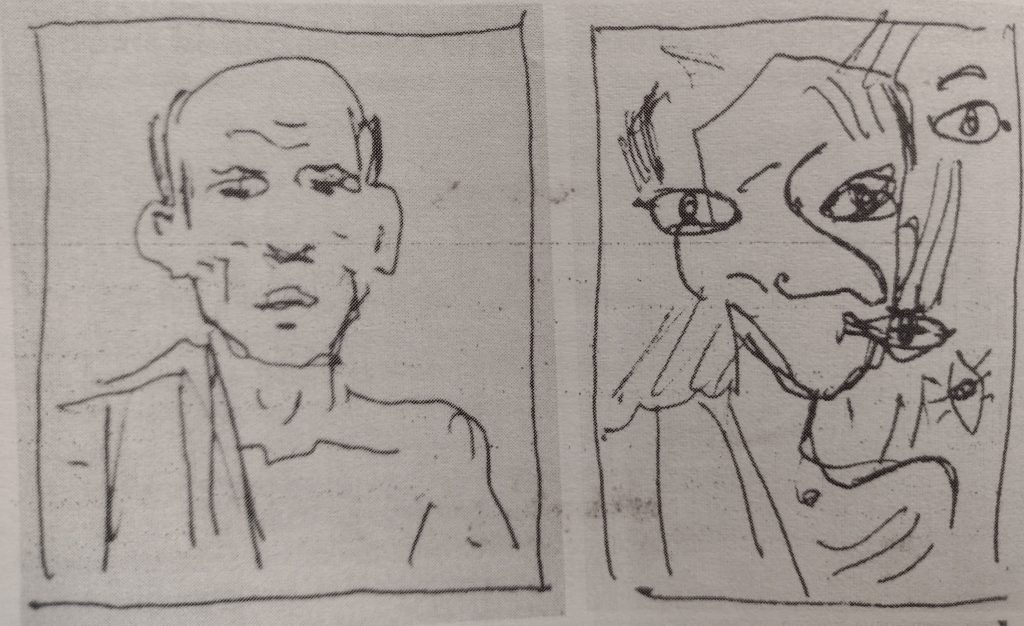
This masterpiece took me not even 15, but 10 minutes. The reaction was expected: Mikhail Alekseevich, so you can! What are you doing like that? Here I already had the right to explain – to do such nonsense as I demonstrated to you, you do not need to have talent, or schooling, or an honest attitude to art. Impudence alone is enough. The more of it, the better. And now let’s learn.
Of course, my eagles were completely incapable of anything. I suffered with them for 40 hours. The results were deplorable. During this time, purely for pedagogical reasons, I painted this model from three positions a la Laktionov. Not because I was delighted with his painting, but to show that this was quite achievable, and for the level of my students, and useful. After that, everything I said and did was the absolute and indisputable truth. When a year later I left to teach at the Kyiv Art Institute, I was told that my guys (without me!) firmly held to the positions that I had instilled in them. To them: you have to write in a new way. And they – Mikhail Alekseevich taught us that way and he was right. They gave us bad grades, but they stood their ground, i.e., mine. I was already in Kyiv then and they had no one to rely on.
Somewhere in the interval, when I was not teaching at the college, I was offered a trip to the Senezh House of Creativity, in the Moscow region. I took my wife with me, who had graduated from the collegel by that time. We stayed there for four months and worked hard.
In addition to the huge number of sketches painted there, the most important thing for me was meeting the remarkable master Alexander Pavlovich Bubnov. He was the artistic director there and, unfortunately, a terminally ill man, which we did not suspect. So he told me something that served as the basis for my understanding of painting. Alexander Pavlovich, as they say, “had his eye on me” and promised to organize a trip for me to the House of Creativity of the Moscow organization of the Union of Artists – Academic Dachas. Alas, this did not happen. About two months after my return to Chisinau, it became known that the author of “Morning on Kulikovo Field” had died. Blessed memory to him.
In addition to the sketches, I also painted a picture in Senezh, “On a Nameless Height,” which I managed to show at the All-Union Exhibition Committee directly from there, bypassing Moldova. The picture was accepted and, in addition to the All-Union Exhibition, it also exibited in Mongolia.
Incidentally, Khmelnitsky’s picture, which appeared a few years later (I dare not deny, it is a very good picture), “In the Name of Life,” was essentially a rehash of my picture. In short, during my stay in Moldova, the problem for me was not so much making a thing as having made it, then breaking out of Moldova.
My wife was accepted into the Union of Artists. Not being gifted with the ability to work with my elbows, I still thought to advise her to ask for a recommendation to the union not from just anyone, but from my most bitter enemy, Mikhail Greku. In fact, we were enemies on the basis of our attitude to art. I was and remain and will probably die a supporter of realistic, deep, highly professional art. Greku is an apologist for fashion, i.e. what is now called avant-garde. Excuse me, to be able to do what a monkey can do, and to be proud of it, is that worthy of the title of artist?
My little trick worked and my wife was accepted into the union of artists.
Meanwhile, life was going on. The old people finished our house. One day (my wife was pregnant at the time) a great Ukrainian artist, Mikhail Ivanovich Khmelko was coming. He came for some kind of, as they say now, symposium. He came with the Russian artist Reiner. Reiner was put up with me. Khmelko also came, having drunk a bottle, because in Moldova they don’t do anything without a bottle, just like in Ukraine, Khmelko was a huge guy and not too delicate, he simply kicked out Rainer and stayed the night at my place.
However, to spend the night is a strong word. He did stay the night, yes, and then he got hold of a friend somewhere, a doctor of some sciences, who was in charge of a fishing collective or state farm, and the three of us ended up hanging out for a whole week. I can’t even say approximately where we were hanging out. All the time, despite my fairly strong physical fitness, and I could press a 2-pound weight 30 times with one hand without straining myself, I only came to my senses from time to time and figured something out. All this time we were driven by one taxi driver, whom Khmelko hired right away and until the end. He never showed up at his symposium. I still get terribly upset if I am 10 minutes late somewhere.
Neither Khmelko’s arrival, nor my friendship with Datsko and Mayko, which brightened up my Moldavian life, nor even the fact that for my professionalism I was appointed chairman of the artistic council of the art fund, helped me feel who I considered myself to be. I am not capable of keeping silent if I feel that I should, am obliged to say something. I would speak, and then get hit on the back of the head, often by those whom I considered my allies. It would get to almost anecdotal cases. So, at one of the meetings of the Union of Artists, I spoke out against Grecu; not in the way he usually did, but still quite sharply. Suddenly my Moldavian student, and not one of those who grab stars from the sky, jumps out onto the podium and how he cursed his teacher! The team (not all of them, of course, but the majority) liked it. They appreciated it.
Soon Kuchuk, that was his last name, turned out to be an employee of the Ministry of Culture. Then, when I was already teaching at the Kiev Art Institute, he became the chairman of the Union of Artists of Moldova. So betrayal is not at all a find of the perestroika people. Alas, gradually I began to notice that I was beginning to master the methods of my sworn friends. So, at the Congress of Moldavian Artists, a petty scoundrel, his last name was Zhumatii, who was then the director of the art museum, was nominated for the board.
How petty and stingy this little man acted can be judged at least by this example. They selected my work for the All-Union Exhibition (and the exhibition committees were held in the museum) and after the exhibition committee my work suddenly disappeared. I searched and searched – it was gone. Only after the exhibition was taken to Moscow, my work was found in the museum under some service ladder.
So when his candidacy was proposed, I went and spoke out to the effect that why go around like that on one person – he is the director of the museum and as an artist he must do something, and then he is also a member of the board. The move was purely Moldavian and therefore liked it. To friendly laughter, they did not “load him with responsibilities”.
In the end, I began to think about the fact that I myself was beginning to turn into a petty scoundrel and intriguer. I became scared.
Then I happened to be in Kyiv. Of course, I dropped by the institute out of habit. My works were hanging in the institute museum, too. My diploma painting was on display in the corridor.
Then the head teacher, artist Budnikov, came into the museum. We started talking. He asked how Ryasnyansky was doing in Moldova. He was a strong student. And I said, “Well, I am Ryasnyansky.” And you know, I wouldn’t mind teaching at the institute, if, of course, you’d take me. Of course, we’ll take me. Come on, come. It’s decided, I’m going.
Yes, so I don’t forget. Somewhere around 1966 or 1967, in the summer, the artist Yuri Nikolaevich Shibaev and I were offered a creative trip to the Black Sea Fleet via Moscow. Yura had been on such trips before, but I hadn’t. Of course, I didn’t exactly agree, but I seized the opportunity. So we went. We were overwhelmed with bright plans: we would see exercises, travel, and get stories for the rest of our lives. At least, that’s what I had planned. The reality turned out to be sobering. At the General Staff of the Black Sea Fleet, we were assigned to the cruiser Slava (the former cruiser Molotov), which was moored in the Sevastopol roadstead and awaiting decommissioning. I don’t know, maybe experienced naval men could have seen something else, but apart from raising and lowering the flag, all we saw was: in the morning, sailors scrubbing the deck. During the day, they scrub the deck. In the evening, they scrub the deck. That’s probably all we saw from the sphere of courageous and severe naval service. Well, I made sketches of a Komsomol meeting, a brass band rehearsal, a film showing. In a word, I contrived as best I could, but I didn’t get to see what I expected. I made a lot of sketches, and sketches too. None of this was purposeful. Just sketches for the sake of sketches. Later, based on this, I made 3-4 trivial pictures of a purely genre nature and nothing more.
In short, after about 20 days instead of 2 months, Yura and I got bored and decided to get away. It turned out that it was not so easy to get away. Everything we did had to be shown to the censors, what if we had some military secrets there. That is, even the little that we managed to see and do was under threat. Being a disciplined person, I was completely despondent. Yura turned out to be much more practical and decisive. He simply, without informing anyone, as soon as the boat began to approach the shore, said, – Misha, take all the junk, get in, let’s go. That’s what we did. Everything turned out to be simple. No one was chasing us. No one wrote anywhere. I think no one even remembered us. Yes, but this was, so to speak, an isolated incident.
In the summer of 1968, I went to Kyiv. My wife was still staying in our half of the house, in Chisinau. It was impossible to get a foothold in Kyiv itself, at least with my business qualities, which I completely lacked. Out of habit, I went to Boyarka, dropped in on a friend who had graduated from the Kyiv Art Institute, like me, under Grigoriev, only a year earlier, Pyotr Bilan. We got to talking. He helped me. He had exactly what I lacked in sufficient quantity – business acumen, and, which is a very rare case, combined with high human decency. He introduced me to the leadership of the Kyiv-Svyatoshinsky District Executive Committee, for whom I made a huge portrait of Lenin, designed the stage, and something else, I don’t remember now. They gave me permission to register in Boyarka. I found a room, registered and began working at the institute.
I was given a second year in the pedagogical faculty. The guys who were considered too weak to study at the creative departments – painting, graphics, etc. – were left at the pedagogical department. By the way, almost all the teachers of the Chisinau Art College graduated from the pedagogical department of the Kyiv Art Institute. In short, I started working. In addition, they made me a party organizer of the painting department. The party organization of the painting department included painters, teachers and graphic artists. By the way, I joined the party back in Moldova in 1967. Frankly, I was a good party organizer. In the sense that I did not interfere with anyone doing their job. In more than two years of work at the institute and holding a party position, I actually held only 2 or 3 party meetings, and on the way from the institute to Boyarka I myself wrote up minutes of non-existent meetings and carefully submitted them to the district party committee. Everyone was happy. I am still surprised how I got away with it.
As for teaching the specialty, everything was very serious. I did all the productions, all the academic assignments with the students. Moreover, I started an evening drawing class, which was attended not only by my “pedagogues”. As a result, at the end of the semester, half of my students were transferred to the creative faculties, and I was offered to teach drawing and painting to the graphic artists in the 3rd year. I fought back: what kind of graphic artist am I, I hardly worked with watercolors, have mercy. Never mind, you can handle it. And I did. If anyone was left without a scholarship, it was not because of their grades in the specialty. Based on the considerations that a student should eat regularly, when the grade was approaching, I corrected over all the work. There were almost no Cs, not to mention Ds.
Then they added another group to me, also graphic artists, where Borodai’s daughter studied, a talented girl, alas, who passed away early.
The school year ended. In a month I had to go with a group to conduct a summer internship, and this month I decided to try to paint a picture that I had been hatching for a long time, “Communists, Forward!”
I was least of all concerned with the matter of conjuncture. It was entirely based on my memories of the war, when it was impossible to get up and move forward, but we got up and moved. To some extent, it was also a tribute to the memory of those who remained on the battlefields of war. The solution for the picture did not come right away. I had many options, including, how can I say this, something like a monumental one, with slow motion, stretched horizontally.
When I finally reached a dead end, I decided to show it to Shatalin. He immediately pointed out the option that I embodied on canvas. Of course, Victor was right. The “monumental” solution carried with it falsehood, false theatricality, posing. Having taken up the picture, I was surprised myself at how quickly and easily it went for me. I painted it not even in a month, but in 20 days. True, all the necessary drawings were already ready and the question of how to draw a hand or folds did not arise for me.
Then there was summer practice. We spent it in the village of Kozheniki. It is a wonderful place, on the bank of the Ros. About 100 kilometers from Kyiv. I remember that there were painters with me then.
That same summer my wife came to me. She sold my share of the house in Chisinau. I found in Boyarka near the train station some kind of wreck with an old Jewish owner, constantly scared of something, but generally a nice woman. She had 2 rooms. At first we rented one room from her, and then bought both. I myself had no time to do the repairs and I hired a person who somehow repaired. In any case, it did not leak. With earnings, too, things improved. Again thanks to Bilan. He introduced me to people who organized orders and, since I never slacked off on commissioned work, made them as in good faith as pictures for exhibitions and never missed deadlines, and was also content with any, even very modest, fee, I had work.
Soon, Bilan and I were given a studio on Kazachya Street, where the production plant of the art fund was located. In order not to waste time on the commuter train, I bought myself a moped and rode it to the studio and back. I rode at any time of the year and in any weather. I never missed a single republican painting exhibition, I participated in all of them.
With the painting “Communists Forward!”, it turned out to be a story that was already familiar to me. The contract for it with the Ministry of Culture was for 2 thousand rubles. When closing the contract, they reduced the price to 1,500 rubles. Then, over the course of several years, it was reproduced many times. In total, I counted 17 times. This is what I saw myself, I know, I counted. Afterwards I was in Chisinau, I went to an exhibition, I don’t remember what it was about, and I saw a huge painting by Grigorashchenko with the same name as mine. God, what a ridiculous painting it was. A talented artist humiliated his talent so much that he depicted Brezhnev leading soldiers into an attack. Grigorashchenko’s Brezhnev was in a leather jacket, with a pistol in his hand, in a very heroic pose. I don’t know about anyone else, but this painting didn’t evoke any feelings in me, except disgust.
Things were going well for me at the institute. Among other things, I was entrusted with editing the institute wall newspaper. I just remember as a funny episode – in the New Year’s issue I suggested to the art students to compose something with scientific phraseology, clever words and turns of phrase, but with the condition that it should be without any sense. I must say that they coped with it brilliantly. How akin it turned out to be to what art critics are now writing, but devoid of a sense of humor, about various kinds of avant-garde artists, in what pompous words they reveal the deepest meaning of the complete nonsense happening on the canvases of “geniuses”. Note that there are no avant-garde artists who are not geniuses. True, most of them are deeply untalented, but that’s a completely different matter. There are countless herds of laughing and gobbling “geniuses”, but somehow I can’t recall a single work created by them, but everyone knew Yablonskaya’s “Bread”, Puzyrkov’s “Chernomorets”, and Melikhov’s “Taras Shevchenko at Bryullov’s”.
Everything was going well for me at the institute. From teaching I was promoted to senior lecturer. My group stood out for its high professionalism.
Things were bad in the family. Scandals. My wife was abusing her own five-year-old son. At the same time, my eyesight suddenly weakened. I had to resort to glasses. Some suspicious characters started hanging around my wife. They started pointing fingers at me – it was the husband of that very artist.
Summer came. I took students to summer practice in Kosov. It was a miracle. Fabulous beauty of the landscape, an atmosphere of friendliness, brotherhood and work, work. I don’t remember now how many students I had there, at least 20, but we stuck together as a single family, although there were not only my schedules there, but also “pedagogues”. The month flew by like one day. As always, I worked together with the students, completed all the tasks I gave them, did not hide anything from them, including my failures. I would have continued working like that, but my resignation letter was already lying at the institute and the students knew that we were about to part ways. I was to be replaced by another teacher, Shostya. When we parted, my students scraped together the rest of their stipend, bought an inexpensive ceramic tea set, signed the bottoms and gave it to me as a keepsake. I still keep it. This inexpensive tea set is one of my most precious things. On the bottoms there are signatures of such now-famous artists in Ukraine as Popinov, the winner of the gold medal of the USSR Academy of Arts, Honored Artist of Ukraine, the artists Skakandiy, Petrenko and others.
I said goodbye to the students and returned to my Boyarka. On the one hand, I was offered to head the drawing department at the institute, but on the other, if I had stayed, there was a real prospect of ending up either in the grave or in the dock. It got to the point that I was chasing all sorts of trash around Boyarka with a knife. I went to court. There they told me that the child would be left with the mother under any circumstances. It was dangerous to leave a son with such a mother. Then the news of my father’s death arrived. I went. Buried him.
I returned and the question of the need to move somewhere came up. I learned that a regional organization of the Union of Artists was being formed in Mykolaiv, they were giving out apartments and studios. I wrote to Datsko, who moved to Mykolaiv after my departure for Kyiv. He came to see me. Then I went to Mylolaiv, looked, made sure that all this was true and moved. In Mykolaiv I was given a good apartment with all the amenities in the House of Artists, specially built to attract members of the Union of Artists, and there was also a studio there, which was allocated for me and Datsko – 60 sq.m. I took part in the organizational meeting of the regional organization. The artist from Kharkov, V.N. Lapin, was offered to be our chairman.
At first everything was very good and nice, we worked together, relaxed, but then the further it went, the more noticeable it became that the organization was not actually headed by Lapin, but by his wife. For some reason, the artists did not like this. The organization began to split into those who came from Kharkov and from other places. I tried with all my might to somehow reconcile the warring parties, to restore the integrity of the team. I failed to do this, both sides began to look at me with apprehension. I had to choose. Of course, I took the side of those who were the opposers of the subordination of the creative team to someone’s wife. When it became clear that Lapin would not be able to hold on to his post, there were few of us then – 10 or 12 members of the Union of Artists, gathered in the regional party committee and offered me to head the regional organization. I thanked them, but refused, saying that we currently do not have a more suitable person for the post of president than N.F.Berezhnoy. That was decided. We made Berezhnoy soon after his acceptance into the party. Everything was fine for several years, until the “Fuehrer” organizations of N.F. quality began to be increasingly agreed upon. Administrative qualities, even of good artists, are always, by nature itself, limited, almost without exception. Berezhnoy, which is quite natural, would like to be the very first. Since he had already reached his creative ceiling by this time, he chose a path that was far from the best – since he cannot rise above those who are above him, he will crush them, belittle them, and in this way he will end up above them. This and other similar policies led him to collapse in the future. He is an intelligent, businesslike person, a good organizer, but what a megalomania!
By that time my old dream had come true – I bought myself a Zaporozhets car. I left my moped in Boyarka and gave it to my neighbor. By the way, thanks to that moped I not only painted a small-sized picture, which I consider my luck, “Memory”, but also acquired a friend for many years, Viktor Petrovich Artamonov, a simple mechanic from Tarasovka, neighboring Boyarka. A simple and not so simple mechanic, but with golden hands, a bright head and an honest soul. Not far from my home in Boyarka he had a small workshop for repairing all kinds of household appliances. I once went there to repair my moped and without any discussion paid the amount that Artamonov named and which significantly exceeded the real cost of the repair. The thing is that at that time he was sitting without money. He liked the fact that I didn’t haggle that in the future I could easily turn to him with any request regarding equipment and he, if he could (and he almost always could), would help me out. Later, this relationship developed into a strong friendship. We are still friends. Every time I find myself in Kyiv, I try to stop by to see him in Tarasovka. Unfortunately, Viktor Petrovich has been drinking lately. Not just drinking, but drinking heavily, immeasurably. A wonderful, kind person is dying.
So about the painting “Memory”. When I still lived in Boyarka, I shared with Artamonov my idea to paint such a painting: a grandfather, a front-line soldier, and his grandson, a Suvorov cadet, came to the places where the grandfather once fought. The grandfather is sitting near a destroyed pillbox, lost in his memories, and the grandson is standing frozen, imagining what once burned, thundered and exploded here. When I told my friend about this plot, he said, I know a place like you need nearby. Get on my motorcycle, let’s go. Indeed, what he showed me with not so big changes was included in the picture. In addition, we were there in the weather I had in mind and this additionally helped me to feel the music of the future picture. I painted it already in Mykolaiv.
I bought a Zaporozhets, got my license and became much more mobile. How many collective farms I drove on it, how many foremost workers I painted, how many landscapes (at first bad and very bad) it is impossible to count.
Once upon a time, any member of the Union of Artists could easily go to the House of Creativity, in particular to Sednev, near Chernigov. The Zaporozhets helped me out more than once. What Sednev is – it is neither possible to say in a fairy tale nor to describe with a pen. To put it simply, it is an encyclopedia of the Ukrainian landscape. This is simplified. In reality, poems should be composed about Sednev and multi-volume novels should be written. You can come to Sednev year after year, in winter, spring, summer and autumn, work every day from morning till night and still never rewrite all its beauty, poetry and musicality. It was not for nothing that Taras Shevchenko loved it so much, it was not for nothing that Grabovsky wrote “There Stands a High Mountain” there. Well, how many wonderful landscapes have been painted by Lomykin, Zakharov, Shkurko, Kogan-Shats and many, many others! And how many have not yet been written! And I’m afraid they will not be written.
Now, in order to get to Sednev, an artist must somehow get 200 dollars. Dollars are now found in those who know how to make them, and good artists only know how to make good paintings for which dollars are not paid. Once upon a time, artists would travel to villages in teams, and painted portraits of the foremost workers. When I got a Zaporozhets, I usually went out in it and then drove around the nearest villages. From each of these trips, I rarely returned with less than five portraits. Not sketches, but portraits. Such training led to the fact that I could manage a portrait in 1.5 – 2 hours, and only if the work just didn’t go well, then in 3 hours.
There was even a case when I came to paint a tractor driver. I laid out the paints, but the tractor driver just didn’t want to pose. I tried to persuade him this way and that, for about 20 minutes, but he still didn’t agree. While I was persuading, I was painting. By the time he finally said no, the sketch (in this case, a sketch) was ready. This sketch was included in the republican exhibition. Painting something similar was not a problem for me at all. The problem was to find a solution in each portrait that would be different from my previous works, and even more so, from someone else’s. Moreover, the solution had to be found instantly and then get to work. Walking around with your head up in inspiration, waiting for a brilliant idea to descend into it, was simply impossible, because we were dealing with very busy people. Of course, there were breakdowns, when it turned out similar and nothing more.
Experience was accumulating. When I was offered to go to the Vinnitsa region with a group of artists, I went with pleasure, and what’s more, when I was assigned to collective farms, I found myself in a group of three with my friend, whom I had met and become friends with in Sednev – Viktor Ivanovich Klimenko – from Cherkassy, and also an artist from Kherson, Brailov. I don’t remember, it seems that at that time I was already Honored. The collective farm had a winemaking bias, it had its own winery. The party organizer was young and the nicest person. What kind of wines, liqueurs and tinctures we didn’t try. I already begged, well, have mercy, my heart is sick, and the party organizer – nothing, as long as you himself is healthy. With all this, we worked terribly hard and when the time came to do the next exhibition in Vinnitsa, when all the artists came, we looked decent.
I was told (I didn’t see it myself) that a good artist from Vinnitsa, also Honored, last name either Soroka or Sinitsa (I later saw his painting at a republican exhibition, superbly painted with women in a cabbage field) and he, upon seeing my portraits, began to tear his works off the wall, trample them and spit.
Yes, at that time I already had the title of Honored Artist of the Ukrainian SSR. In the regional organization of the Union of Artists of Mykolaiv region, I was the first to receive this title.
The story of how I got it was also interesting. I was turning 50. It was in 1976. As I understand it, Berezhnoy decided to try me out as a guinea pig, to see if I would succeed or not. We prepared all the papers, sent them off, and suddenly they gave it to me. This served as a signal that it was possible. Berezhnoy, Zavgorodny, and Makushin immediately began to fuss. They succeeded too, and Berezhnoy even aimed for the title of Honored Worker of Art and received it. But that was a bit later.
A lot of people gathered for my 50th birthday. The weather was terrible, the rain was so bad that you could barely see 10 meters away. Suddenly, just as it had just begun (and it was in a restaurant where they had rented an entire hall), Odessans, the wonderful artists G. Kryzhevsky and V. Tokarev, came in. In this terrible weather Kryzhevsky drove 150 kilometers in his “Zhiguli” to congratulate his friend.
We were great friends. Our friendship began in Moldova, where Grigory Kryzhevsky and Vladimir Vlasov once brought their exhibition. Both are wonderful artists, real, great masters, not magicians and prestidigitators, but masters. Suddenly Greku in his cheeky and impudent manner “rolled a barrel” at the masters who are a head taller than him. I went out and gave him a rebuff. The discussion of the exhibition was triumphant. The fact that Greku became the last laureate of the USSR State Prize is completely logical. This was the beginning of a rabid attack on professionalism in painting, an attack supported from above, and Greku, as a destroyer of realistic professional art, had by that time crawled out of the framework of Moldova and, since demand creates supply, led the fight against art on an all-Union scale, for which he received an award. This happened later, and from the moment of my open speech in defense of masters who did not need protection, my friendship with Grigory Zinovievich began. It is impossible to describe what kind of person he was. The brightest, most beautiful words will be petty and helpless. First of all, an Artist with a capital letter, an amazing painter, who worked with seemingly dull colors, but so exquisitely, with some special hidden aristocracy, that next to his works, the bright, juicy, ringing painting of other masters looked like a signboard. And the man! – He was an Odessan in the best, one might say, refined form, witty, resourceful. He was witty not with someone else’s, repeatedly tested witticisms, no, his reactions were targeted and lightning fast, biting, often aphoristic. His biography was such that it would have done credit to anyone. A combat officer – a tanker, who fought long and bravely. At least the fact that only two people remained from the unit in which he fought. Well, and a man of impeccable honesty, decency. No, these are all wrong words.
Kryzhevsky was much better than I described him. What a pity that we had to live in different cities. What a friend! In 1982, my wife gave me a heart attack. I spent 2 months in the hospital. If I came out alive, then not very much. Suddenly Kryzhevsky was arriving. Misha, do you have any scenic places here? Yes, I say only one place – Migiya. One, but what a place! Get in my car, let’s go. We arrived in Migiya, pitched a tent near a ruined mill. Ten days on the river bank, in a fabulously beautiful place, under the care of a friend who looked after me like a mother of a small sick child, did their job. From Migiya Kryzhevsky brought a completely healthy man to Mykolaiv. Kryzhevsky himself hardly painted then – he fussed over me.
I got distracted again. It is impossible to remember how many trips I have had in groups and alone, but I remember one more trip – it was a trip to the border. An exhibition dedicated to border guards was being prepared. The artist Olshansky, also from Mykolaiv, and I were offered to go to the Romanian border. At that time I already had a Zhiguli. I loaded the canvases onto the trunk, put Olshansky in the car and off we went. We were in different places. Olshansky, a graphic artist, he traveled light compared to me, stayed in the city of Reni, near the port, and I went further north, to the outpost. We worked there for a relatively short time – 10 days. The thing is that I took 8 large canvases, thinking that they would be enough for 1.5-2 months of intense work, but it turned out that in 10 days I somehow got all 8 and all at exhibition level. It’s funny that the outpost turned out to be a kind of “literary” one. There I painted a huge, life-size portrait of Corporal Bulgakov standing with binoculars at the border. There I painted Corporal Chekhov and, if I remember correctly, Private Lermontov. One of them is on the platform, like a Komsomol organizer, and the other is writing a letter in the evening; I called this picture “Dear Mom…”
Of the 8 works painted there, 4 were exhibited at the republican exhibition. I slightly rewrote one of the remaining ones, remaking the border guard’s uniform into a police uniform and it was exhibited at an exhibition dedicated to the police. It depicts the moment when a dog is pouncing on a criminal, a wounded policeman is lying on the ground, and from afar, from the fog, another policeman is runnig up. I called it “Especially Dangerous.” The history of this piece is curious. I could not find the dog’s movement. I shared my trouble with the border guards and they arranged a special training session for me. There were two service dogs at the outpost. One was normal-sized, and the other, nicknamed Lord, was a giant, weighing about 80 kilograms. This Lord was demonstrating his training to me. He was paired with a guy, also a “small one”, about 100 kilograms, maybe more. They put a training suit on the guy, one that the dog couldn’t bite through, and started demonstrating. Soon the soldier screamed: get this devil away from me. Lord dragged the poor guy all over the outpost yard, thrashing him like a rag. I wouldn’t want to be in his place. Later, I gave this painting and another one, which I called “The Precinct Officer”, to the regional department of internal affairs, where they are now on display in a museum.
I also had to work hard on the construction of the South Ukrainian NPP. None of us had yet imagined Chernobyl and we were enthusiastic about the construction of the NPP, we worked hard. Now I can’t remember exactly how many portraits I painted there, but no less than 12.
The atmosphere around me was getting thicker. If the importance of an artist is to be judged by the number of envious people, then my importance was beginning to acquire a threatening character for me. Berezhnoy was at the head of this campaign. The same one whom I made chairman. It is impossible to list how many small and big dirty tricks he did to me, and I don’t want to. He surrounded himself with a guard of fellow countrymen – Omsk residents, mainly graphic artists. Graphic artists occupied all the posts. Graphic artists gave themselves the highest-paying painting jobs, earning more than painters on painting. I spoke about this several times at meetings, and everyone, including painters, pounced on me, wanting to demonstrate their personal loyalty. As an artist, I was saved only by the fact that a thematic picture, where there is some kind of plot, where a convincing drawing is needed, no one in the Mykolaiv region except me, and to some extent V. Semernev, could, and still cannot, master.
Then the time came when they started making a shipbuilding museum. The first violin was a very talented designer from Omsk, Steshin Yu. I was also offered to participate in this order. I painted 3 thematic pictures and several portraits. I do not take the portraits seriously, because they are based on old engravings. The pictures are not entirely my autor`s works.
As soon as I finished this work, my wife gave me a heart attack. I was still moving with terrible pain in my chest. I saw Berezhnoy, asked him to take me to the hospital, he promised. When it was time to go, I found him, reminded him, but he was already drunk. Our photographer took me on a motorcycle. At the hospital, they examined me, immediately put me on a stretcher and carried me on a stretcher to the ward.
Already in the hospital, I got acquainted with the list of people nominated for the state prize of the Ukrainian SSR for the shipbuilding museum. As expected, I was not on that list. Out of 11 people, only 3 were artists. Of these artists, only two did anything, and the third was Berezhnoy’s adjudant. He didn’t include himself in the list, though. Maybe because he didn’t participate in the work on the museum either. Steshin was the artist who deservedly received the award, but he wasn’t included in the list at first either.
After leaving the hospital, the situation in the family became increasingly tense. The fact that our daughter Viktoria was born in 1974 did not ease the situation, I was forced to escape scandals in the studio, but my beloved got to me there too. In the end, one day I could not stand it and slapped her in the face. I am convinced that in that situation even Jesus Christ himself would not have been able to stand it and would have done exactly the same as I did. Finally, she got what she wanted – a divorce. The marriage was one of convenience – by that time I had almost finished building half the house and a divorce of convenience. She took away my apartment, property, children. At that time, my son was studying at an art college in Odessa and I rarely contacted him, and she hid my daughter from me and did not let me meet with her. They did not listen to me in court, especially since tears were shed. How could the court leave a child to such a “monster”.
I lived another two years in the workshop. Even after the divorce, suddenly in the middle of the night there would be a knock, a crash, a foot on the door – she would come to quarrel. My appeals to the board of the Union of Artists resulted in the obedient, loyal servants of Berezhnoy executing me. With sadistic pleasure. They executed me, I understood perfectly well, first of all because I knew how to work. Some of them would come one by one – “You see, I couldn’t do otherwise, it’s scary to conflict with Berezhnoy, you must forgive me”
I decided to move somewhere. I was offered help to settle in Vinnitsa, Chernigov and Cherkassy. I settled on Cherkassy, where my good friend Viktor Ivanovich Klimenko lived and worked, a good artist, to whom I was nevertheless sometimes useful with my connections. There, I will not say that everyone perceived my appearance with enthusiasm, but most reacted positively, allocated a good workshop on the scale of Cherkassy.
There they were preparing to open a local history museum and I, along with other artists, was given a commissioned work, to paint the picture “The Battle of Hetman Kontsovsky with the Poles”. The size is quite small, but I got carried away and made a multi-figure battle and I think it is quite good.
There, through Klimenko, I met Raisa Kirichenko, who had just received the title of Honored Artist. Since Viktor decided to paint her portrait, I joined in and painted it too. Then I made for Raisa not exactly a copy of the portrait, but rather a variant. While maintaining the resemblance, I made it somewhat aristocratic, and perhaps this helped the imagery of the portrait. Raisa Kirichenko was a sweetheart as a person, I don’t know how she is now, but she was a sweetheart back then. I remember the dumplings that we made under Raisa’s wise guidance and with her participation in Klimenko’s workshop. He, by the way, is a pretty good cook himself. I was, in general, “on hand” and compensated for my modest participation in the creation of dumplings to some extent (of course, it wasn’t limited to just dumplings; there was something else besides dumplings) by singing. Yes, yes, not Raisa but I, inspired by a solid dose of vodka, sang to the wonderful singer. I am still touched by my own impudence.
I made a personal exhibition in Cherkassy. It included many portraits of Cherkassy residents. The exhibition remained in Cherkassy. In short, my affairs in Cherkassy began to improve, but my soul ached for the children left to be devoured by the monster.
Suddenly news from Nikolaev – I was offered a room in a hostel there. Although I felt like a traitor to the people of Cherkassy, I returned to Mykolaiv. The hostel was located about 10 minutes walk from the House of Artists, where my studio and apartment were. Right next to the hostel was the school where my daughter studied, but my daughter never dared to come to me – she was afraid of her mother. So it was possible to live there.
True, opposite my door there was a door where a drunk lived, beating his wife with his child. One day I could not stand it and although my strength was not what it used to be and I was over 60, I intervened. I twisted his arms and warned him. I did not beat him, after all he was a neighbor.
A bright moment for me was when in 1984 I was found by the council of veterans of my 108th Guards Division. Remembering the losses we had suffered during the war (to be fair, we made inflicted even greater losses), I was sure that nothing was left of my division, and suddenly the division was found, or rather, I was found, and there were about 300 veterans registered. True, of those with whom I had been personally acquainted at the front, there was only one, Aleksandr Mikhailovich Kaminsky, a scout. When I fought, I was 17 years old, and Sasha was even younger – 15. Still, the knowledge that people with whom I had fought the enemy in the same military unit were nearby inspired and still inspires me.
The 40th anniversary of the victory in the WWII was approaching. I had conceived the painting “The Winners”. In it I wanted to depict a festive Sevastopol, along the streets of which people who broke the back of the fascist beast walk with unfurled banners and their heads held high. I specially went to Sevastopol when they celebrated the 39th anniversary of the Victory there, made drawings, sketches, took photographs, but the compositional solution did not come together. And so, after the division and I found each other, I began to think – why Sevastopol itself? And why sailors? And what’s wrong with my 108th Guards Rifle Division, and even Nikolaevskaya, which gave the Motherland 22 Heroes of the Soviet Union? That’s it, I will paint a picture based on my division and so that all the characters have a portrait resemblance. The compositional solution was not determined in any way, and without it, making sketches, drawings is nonsense.
And time went on, winter began and only then I finally decided. Well, come what may, my car was in good condition, I got in and drove off.
The division was formed on the Taman Peninsula in the village of Krymskaya from two brigades: the 4th Marine Brigade and the 10th Airborne, formed in the city of Ordzhonikidze and participating in stopping the Nazis on their way to the oil. Since the division was mostly formed from residents of Kuban and the Caucasus, who returned to different places after the war, I drove through the Rostov region, Kuban, Ordzhonikidze, along the Georgian Military Road, to Sochi, along the coast, to Taman, from there by ferry to Crimea and home. The winter was fierce, snow, blizzards. If you add that although I drive a car pretty well, but in the event of repairs, I am completely helpless, my voyage was a crazy adventure. However, nothing, everything worked out.
Only when I was already leaving Crimea, I experienced a scary moment. The road was covered with perfect ice. You could shave while looking at the road. I was driving at a speed of 15 km per hour, avoiding to step on the gas or the brake. And yet I was smoothly and solemnly carried off the road. Luckily, I didn’t flip over. I went down from a height of about 1.5-2 meters. And the road was empty, crazy wind, cold. Not a house anywhere, nothing. Frankly, I got scared. I stood on the road for a long time, chattering my teeth. Suddenly something appeared from afar. Oh joy! A tractor drove up. With huge wheels, taller than a man. It pulled me out. Luckily, I had a strong rope. And then I got there.
A picture is a picture, but I also had the idea to create a gallery of portraits of my fellow soldiers. I took it on and really, in addition to the painting, I painted more than 50 portraits, donated them to the 2nd secondary school in Mykolaiv, which served as the basis for the 108th Guards Museum created at the school. In addition to the Caucasus, I had to travel to Kyiv and Moscow to create the painting. The painting was exhibited at the republican exhibition in the so-called “Pharaoh’s Hall”. I myself was dissatisfied with the painting and made a repeat. It seems to me better and I also donated it to the 2nd school. Recently I made another repeat, or rather, a variant. I am happy for now, but I don’t know what I will think in a year.
Meanwhile, Berezhnoy was becoming more and more brazen, having established a sort of monarchy. His loyal subjects sang his praises, he was treated abroad, which was a rare occurrence at the time. He went on business trips abroad, and created a sort of personality cult for himself. Through his mistress, who was as scary as a hundred deaths, but who held a post in Moscow, he even managed to get into the Tretyakov Gallery.
A woman of any beauty could become a member of the Union of Artists only if she was favorable to the advances of the chairman. All this taken together led to the fact that I once, taking advantage of the fact that due to the oversight of the chairman I ended up as a member of the audit commission, rummaged through the accounting department and published a list of salaries, and of cours, all the graphic artists, regardless of their degree of talent and skill, turned out to have earnings one and a half to two times higher than the painters. This despite the fact that they earned money from painting. Well, and since salary, earnings, money are the most tender and vulnerable place of most creative workers, then the painters united, sculptors, applied artists joined them and after 17 years of autocratic rule of Nicholas III, he was overthrown.
It is impossible to say how much dirt was poured on me, I am still washing myself off. They made the artist Burlaka V.S. the chairman. He painted us such rosy pictures of how he would lead us to the shining heights of a bright future that we pricked up our ears and elected him by a majority of votes. Alas, he turned out to be the same rogue and swindler. He did not strive for honors, but he tried to extract the maximum benefit from his position. He appointed his friend, a certain Cherke, as the director of the production plant. He did everything in his power to destroy the plant so that the artists would be left without work and he succeeded in this quite a bit.
Personally, this Cherke also did a unique dirty trick on me. We all remember the terrible tragedy when Armenia was shaken. The entire USSR rushed to help Armenians cope with the consequences of the disaster as best they could. The Mykolaiv region did the same. The Mykolaiv region sent many builders, and a cultural brigade to support morale.
An announcement was posted in our regional organization of the Union of Artists calling for people to join in. The announcement caused mass enthusiasm. As many as 1 artist signed up. That was me. We flew to Yerevan by plane. From there we took a bus to the village of Shirak. We arrived at night. I took paper, pencils, and paints with me. Even before boarding the plane I felt terrible – my head ached, I felt nauseous, my joints hurt. I gave my word – I had to go. Immediately upon arrival, I took up the only thing I knew how to do and could really help with – I began to draw portraits of the best builders with the aim of subsequently exhibiting them in their native places, in the Mykolaiv region. I also made several landscape sketches, including an external view of the barracks where we were housed. Of course, we could not agree with the concept of a barrack, and our abode, at least among us, was called proudly and sublimely “Hotel Shirak”. The concert brigade was moderately busy – in addition to several concerts for the builders, they made several excursions around Armenia. That was all they were busy with. I, despite my illness, worked like hell. I don’t remember how long we stayed there, but not long – maybe five, maybe seven days. I made more than 30 pencil portraits of the best builders and wrote down their home address on the back of each one, so that later, after the exhibition, I could send it to him. In addition, on the eve of my flight from Armenia, I pasted the portraits onto a long sheet of wallpaper in the dining room and put them on display.
When I was preparing these portraits for the exhibition, a funny incident happened. Some guy showed up in the dining room, pretty drunk, and started hitting on me. I found myself in a difficult situation: I was sick, but remembering my boxing I could still give the troublemaker a good slap in the face, but on the other hand I was a guest in Chirac and it would not be fitting for me to justify my actions. Help came unexpectedly and very effectively. A figure about one meter ninety tall, impossibly broad in the shoulders, appeared in the doorway, and behind him were three or four more of the same “small ones”. It was a retired captain who had previously commanded a company in Afghanistan. He quickly figured out what was what. The guys closed in on the troublemaker. A faint squeak was heard. Then they parted. The “hero” was gone. I don’t remember how the whole brigade, and I was already so bad that I had to leave.
Returning to Mykolaiv, I spent about a week in bed. I had to fulfill my promise to the builders – to make an exhibition of portraits. The board decided to organize the exhibition. This decision was passed on to the director of the plant, Cherke. Despite repeated reminders, this son of a bitch (I can’t find anything softer to describe this person) dragged it out for several months and dragged it out until the war between Armenia and Azerbaijan began. At this point, my exhibition was completely unnecessary. And I turned out to be a chatterbox in front of the builders, although I was completely innocent of this.
This was not Cherke’s only “feat” as director. With great difficulty, we pushed Cherke out and put another friend of his, Gurevich, a candidate of economic sciences (according to Burlaka), in his place. Burlaka talked the team into believing that this candidate of sciences would write a work in which he would describe everything about how the plant would quickly and effectively get back on its feet and we would all earn a lot and easily. For this, the candidate of sciences was supposed to receive 7 thousand rubles. At that time, it was a huge amount of money. The candidate of sciences scribbled some nonsense, something very abstract, equally suitable for a sewage disposal trust, but he received money from a ruined, impoverished organization.
Things at the plant came to a standstill. Work disappeared. Now they had to fire the “candidate” too.
Burlaka acted even more disgustingly towards his fellow artists. Having taken up his post, he started a conversation about having an agreement in Seattle (USA) about us holding an exhibition and selling our works there – give us our best works. We will be rolling in money. They believed him. They gave us. I gave him 10 really best, relatively small works. And then the dragging began. Burlaka and two artists went to America, got some of his own business done there. He answered all our questions about the fate of the works evasively, dragged it out and fooled us. We never saw our works or the money again, although we learned that some of our works were sold. In particular, my “Nude” was sold for $850. Our “benefactors”, after their trip to the USA, acquired some junk. Burlaka, in particular, got a car. The businesswoman who was in charge of our exhibition presented the organization with a fax. This fax ended up with Burlaka, he never gave it back. Since at that time you could buy a very decent car for $850, I have every reason to believe that Burlaka drives my car.
At that time, the so-called perestroika had already begun, “business people” became respected, for some reason the common people call them crooks. Several times we attempted to sue for our property, but each time it ended in “zilch”.
I also had a case when “business people” cheated me out of it, although in this case I think I will be able to get back what was taken from me. Back in 1991, when “gorbostroika” was just beginning, various firms began to appear, two smart young men from Moscow showed up (this was before Burlaka’s scam) and suggested that we take your paintings, show them at exhibitions, reproduce them, sell them (including for dollars) so that you have no doubts, we will conclude a written contract with you, pay a 15% advance. At that time, there was no “MMM”, no “Svityaz”, no Lenya Golubkov, we believed in the reliability of documents, seals, signatures. We knew that the government would always protect us, we knew that crooks belong in prison. I let them rummage through my works. They selected 18 of my best works at that time, including those that were reproduced in magazines. And so it began: first, the advance payment, which according to the contract was supposed to be transferred to me within a month, I knocked out of the company for 7 months, and then, after the contract expired, the dragging began with impudence to the point of simply unthinkable “gorbostroika”. In the contract, from the very beginning, the prices for the works were very, very low. In this regard, when the contract was signed, I was told: what does it matter, it’s a pure formality. At the end of the contract, when I demanded in a telephone conversation with the general director of the company “Premiere” Durov either to return my works or to pay, I was told: well, please, the amount is indicated in the contract. The prices at that time had already jumped a hundredfold. In short, I had to go to court. By the time I got a court hearing, several years had passed, and here too I had suffered so much from official tyranny that I was involuntarily grateful to those who do not allow me to have a weapon. Otherwise, I would have been in prison for premeditated murder. I recently received a message from Moscow that my claim was satisfied. Yes, but now I have to go to Moscow for the second time (I already went there once and it was useless), not yet knowing how all this will turn out. It is very possible that the businessmen have already disappeared somewhere.
Now the mania to do worse, but something different has already affected the Union of Artists and the Art Factory. What will this lead to? I’m afraid that it will lead to the disappearance of such a profession as an artist. For my part, being a dinosaur in my convictions, I continue to teach art. It is not for nothing that they say that a smart person loves to learn, a fool – to teach. Unfortunately, 25 years ago, an art school was opened in Mykolaiv. A wonderful building was allocated for this. To teach there, they recruited someone’s wives and other relatives, who have about the same attitude to art as a plumber from the housing office to growing violets. Since the above-mentioned ladies have a very distant idea about art, they teach based on the following postulate: in order to teach, it is not necessary to be able to do it yourself. Charming!
At first, a good grafic artist B. Kolodyazhny was the director there, who recruited these teachers there. Then, when it turned out that they were only harmful, when it turned out that they were incapable of teaching anything, when he began to insist that the art school provide some kind of school, they kicked him out. Now it is God’s grace there: children appear and draw like children. Their drawings are taken to various exhibitions and even receive awards, but children have a strange property of becoming adults. A boy or girl is already interested in the opposite sex, and he or she is forced to hold a finger in their mouth and coo like a child. The school, for which parents paid money and hoped to receive the basics of professionalism, the school does not and cannot provide. There are no people there capable of providing this school. I have repeatedly raised the issue in the press, on the radio, and at various meetings, etc., etc., about opening an art college on the material base of the art school, but in vain.
One high-party, and now highly anti-party lady said directly – we will not allow children to be deprived of art school. It sounds proud and she looked correspondingly proud. It was impossible to hammer into her straight line, replacing the convolutions of the brain, that there are quite enough art circles like the art school in Mykolaiv and there are better ones among them, but there is no place where children could get an art education. At least she directly and pointedly demonstrated her ignorance and unwillingness to delve into and understand the essence of the issue. Other officials were, and still are, concerned with only one thing – that incoming and outgoing people come in. That this very art school is nothing more than a place where talented children are turned into mediocrities for parents’ money, no one’s heart aches.
In short, I don’t remember when and how it started, but for many years now talented and not so talented kids have been coming to my studio and I’ve been messing around with them. There is space for 3, sometimes 5 people. I don’t make any selection. I don’t take anything from them. If less than half of those who have been trained by me and are applying to an institute or college are accepted, I consider it a failure. Those who are accepted, as a rule, set the tone in the educational institution. It’s a shame, a very shame that I prepare personnel for educational institutions, when if I had the right to issue documents, I could prepare them much better than indifferent people who, alas, are not always true professionals. Even my former students who graduated from art institutes often come back to me and I help them find their own style and the professionalism that was not given to them at the educational institution. It sounds a lot like bragging, but unfortunately it’s true. There are many willing people who want to benefit from my idea to open an art college in Mykolaiv, but no one is ready to help.
I missed another point – the relationship between artists. It is natural that each artist considers himself the best of the best. There is even such a historical joke – in ancient Greece, a competition was announced for the best statue of Aphrodite, and on the most democratic principles. The sculptors themselves had to determine the best of them. Each of them, naturally, named himself first, but everyone named Praxiteles second. So he became the first. So what is this for. Recently, the artist Antonyuk Andrey Danilovich received the Taras Shevchenko State Prize. I will say frankly, he is a complex personality: on the one hand, at the time of receiving the prize, he is a vile drunkard. When drunk – a boor, a swearer. He drank so much that for 2-3 months, day after day, night after night, he brought himself to an impossible, bestial state. More than once, in my no longer youthful age, I carried him on my shoulders to the door of the apartment, rang the bell and ran away. On the other hand, this is a rare, unique talent, unlike anyone else. It is difficult to characterize his art in a few words. It is like a fairy tale, but not an illustration to an existing fairy tale, but a fairy tale created by Antonyuk himself. On the other hand, it is philosophy, but again not a bookish, abstruse one, but the wise philosophy of a peasant: a song, but not in a well-trained operatic voice, but performed by the open soul of a commoner. All this is supposedly in a primitive, peasant manner of performance. Moreover, all this is Ukraine, painfully native Ukraine. I do not know a more Ukrainian artist. Yes, besides all this, what painting! At times thunderously bright, tense, sonorous, in other cases – restrained, on black-brown nuances, and somewhere subtle, gently nuanced. All this is not by chance, but each time dictated by the music that he sang in his painting. When he created them is beyond the mind. Only recently he has been holding back for several months, not drinking. Otherwise it was hard to see him sober. But he did create! And how he created!
So it was precisely against this artist that a fierce persecution was organized during Berezhnoy’s rule. Actually, it was at the same time that I was being persecuted. He was accused not so much of drunkenness (Berezhny himself drank not much less than Antonyuk, he just did it a little more carefully). No, the accusations were much more dangerous at that time. He was accused of Ukrainian nationalism. When Andrei made his personal exhibition in the art museum, I ran away from the hospital to the opening and said what I thought about this artist. That is, that he was a unique, rare talent and that this exhibition was an event in the spiritual life of Mykolaiv. Soon there was a discussion of Andrei’s exhibition. Andrei was sober. So many people came that they did not fit in the rather spacious hall of the museum. The discussion was a triumph. On the way from the hospital to the exhibition (I ran away again) I composed something like an epigram
A creeping snake without any effort
Capable of strangling and swallowing a thrush,
But whether you praise him or step on his tail,
A snake will never sing like a thrush again.
So what’s the secret here?
Don’t look for the secret,
The question is not at all simple, but the answer is very simple:
There is no soul in a cold, slippery body,
And where there is no soul there is no song.
After that, when I left the hospital, Zavgorodniy (himself a wonderful artist) invited me to his place and showed me the dirt that Berezhnoy had collected on Antonyuk: look who you are praising, who you are fighting for. I remember well what I answered: – Ukraine, with all its wealth, is not so rich in talent that it would be possible to deal with them so easily. The dirt was based on a catalogue published abroad, “Unrecognized Soviet Artists”, which included Antoniuk. Oh, what sedition! I remember that soon on the trolleybus I saw two KGB agents who were in charge of our organization, the Union of Artists. They asked me what I thought of Antoniuk. I answered that Antoniuk’s main guilt before our creative collective was that he was very talented, and this was not forgiven. I repeated this at large meetings of the creative intelligentsia in the regional committee of the CPSU, listening to the then first secretary of the regional committee, Sharaev, the current minister of something. Among the great multitude of people present in the hall, many of whom had been drinking with Andrei, many of whom were considered his friends, I was the only one who openly spoke out in defense of the artist. Yes, Andrei also announced and, as in similar cases, repented of something. It seemed to have let go? But no! The clouds began to thicken again, but the day before, when thunder had to strike, I called a friend, the poet Dmitry Kremin, who wrote and writes about artists; Dima, urgently give the newspaper a laudatory article about Antonyuk, it is necessary. Dima did it.
Soon the miting of united artists was assembled, “distribution of elephants”, some were brought to the title, some – to the order. Semernev was nominated for an order, and I suggested nominating Antonyuk for a title. The meeting supported him. Soon Andrey became an honored artist, and only then was he left alone. Now he is no longer in any danger: Berezhnoy has been removed from power, Andrey has not drunk for several months, plus the ability to use his elbows, which is rare in talented people. Exhibition after exhibition, the widest recognition. May God grant him further unhindered work for the glory of Ukraine. Because, I repeat, I do not know a more Ukrainian artist than Andrey Danilovich Antonyuk.
What about me? I hope to live to see the time when the state will again need artists, when we will no longer depend on circumstances, on moneybags who are not interested in art, who see money only as a way to make even more money. There is nothing surprising here, where would the craving for art come from in a person who has created a large or enormous fortune by criminal means? Somehow I do not know of any case where large amounts of money were made honestly.
By the way, recently a court decision finally arrived from Moscow regarding the company “Premiere”, which stole my paintings. The court obliges the company to return my paintings to me, but at the same time they inform me that the company have disappeared and it is impossible to find them. So it was not in vain that they dragged it out. If we take into account that “Premiere” robbed about 200 artists besides me, then here is another example of how a greater fortune is made.
23/ХІІ. 97.