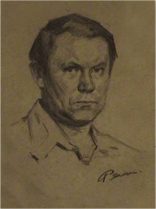
I was born on May 17, 1926. This significant event took place in Taganrog, Rostov region. Oddly enough, the press, radio and television kept quiet about this issue. Ah, yes, we didn’t have television then. It’s still unforgivable. My father was a carpenter, he worked at an aircraft factory. Mother is a housewife. Even in kindergarten, I was called an “artist”, probably because I could draw horses in such a way that it was possible to recognize a horse in my art. Then (I was 3 years old) I learned to read.
Our apartment was located very close to the aviators’ club, and my father took me to the art-club at the aviators` club. I was then 8 or 9 years old. Sergei Aleksandrovich Orlov was in charge of the art-club. He, may his memory be blessed, instilled and instilled in us a love for realistic art. The words “old masters” evoked an almost prayerful state in us. The people in the art-club were “solid”, aged 17-18-20. There was a real artist among us, he made posters for the cinema, his name was Kostya, I can’t remember his surname. How he made still lifes with watercolors! He wrote these still lifes on ordinary school notebooks for drawing, the same as today. And my father somehow brought some pieces of real Whatman paper from the factory, thick, hard, ideal for watercolor… And so I took this paper and brought it to the art-club. There, he casually suggested to Kostya that they exchange my sheet of paper for a his sheet . Oddly enough, he agreed. I don’t remember what happened to me on this bone paper.
I remember this moment well: once Sergey Aleksandrovich said: “It would be nice to get a skull for painting and drawing.” The guys said “it will be done” and dragged the skull and bones with the not yet completely rotten remains of meat to the next lesson. This still life was my first oil work. It is still in my possession. Somewhere, when I was 10 years old, an exhibition of amateur activities of the trade union of aircraft manufacturers was organized in Moscow. Aviation was then an elite type of industry. And suddenly, in this rank of universality, I was awarded the first prize. And adult uncles and aunts were exhibited… In addition to educational still lifes, I also gave several battle fantasies with different horsemen, etc.
After that, we could say that the aviators’ club administration had to appreciate the triumph of our art-club. They appreciated it. The art-club was liquidated. I had to relocate to the Palace of Pioneers. It wasn’t the same there anymore. They smeared who in what town. Meanwhile, I finished the 7th grade of school and dreamed of an art college in Rostov. But my parents decided otherwise and sent me to an aviation technical college. Although I graduated from school with honors (there were no medals then), I was not adapted to the exact sciences, and classes at the technical college were torture for me. “Rescued” Hitler.
The war .The Germans seemed unstoppable. They are already approaching Taganrog. The father is urgently evacuated from the factory. My mother and I are staying in Taganrog. Father only managed to bring a sack of burnt wheat from the burning warehouse in the port. I don’t know how we would have wintered if it weren’t for Vasyl Mitrofanovych Bazilevich, a familiar employee of the History and Art Museum. He helped me get a job in this museum. Alas, he did not last long. He was a Jew.
When the Germans were driven out, I was 17 years old. I was drafted into the army. Got into the 108th city. rifle division. I fought for a short time. I was seriously injured and contused. I was in a hospital in Chkalov (Orenburg). I was there for 7 months. I was “artist” in the hospital. Posters, inscriptions, etc. With a still unhealed wound, I went to my father. At that time, my father was with his factory in Tbilisi. I was demobilized with group 2 disability and visited my father three times on crutches. He lived in a barrack-hostel. I lived with my father for several months and left for Taganrog. I saw how difficult it was for my father, and for me too. I arrived in Taganrog, and soon an art-college opened again in Rostov.
Now, no one stopped me and I, thanks to good training in the art-club, was accepted to the second course in the art-college. I studied for 2 years and together with teachers But Nikolay Yakovlevich (later one of the brightest figures of the Grekov Studio) and Zherdytsky (later a professor at the Kharkiv Art Institute), forged our high school diplomas and went to enter the Kharkiv Art Institute. Passed the exams, entered. I was together with one guy, I forgot his surname, shared the first seats. This boy was hunchbacked, very capable, but he did not live long. He either got hit by a tram or a train.
And my studies didn’t work out either. I had to go somewhere, I entered the tram on my crutches, and there they pushed me, pushed me all over the tram and pushed me out of the tram from the front platform. I tried to enter again, but there was a policeman. I got stuck that I want to enter from the front landing. This is now a disabled person (and not only a disabled person) can enter the tram from the front door. And then – no-no. But most likely the policeman just wanted to humiliate me. He took all the money I had. I didn’t have any money to buy my bread ration. Friends were penniless too. I had no choice but to get on the roof of the train and go home. That was the end of my first attempts to enter the institute.
Upon returning, I graduated from college. My life had improved in the meantime. My friends got hold of some “hack work” – to decorate a market for a holiday. I got to do portraits of the Politburo with a dry brush. In a day, a night and another day I polished 15 huge portraits. But I got a ton of money, bought myself a suit, a coat and still had some money left. And I decided to enroll in Leningrad, in the Academy of Arts. I went, and just in case, I didn’t emphasize my stay during the occupation in my biography. I passed the exams with flying colors. There were other applicants behind me. I painted the head of a model, both the one I was required to and the one for the neighboring group, all the general education ones got 5. Only 4 in composition. The then president of the academy A. Gerasimov, before admitting those admitted to general education subjects, marked those admitted to further exams with circles. All my works were marked (including what I did additionally). I was not on the list of those accepted. I went to find out. The deputy rector, I remember the name Sokolov, said: but you were in the occupation. All my grades were reduced by one point and I “did not pass the competition”. At the same time, V. Tokarev from Rostov city, who had been in captivity and who took the exam with me, was accepted. I still don’t understand anything about this.
I returned to Rostov, started working in the art fund, participated in exhibitions, was accepted to the Union of Artists (then it was …..), got married. But I was constantly haunted by the thought that I had not finished my studies. Somewhere I was stopped by the feeling that something was wrong with the composition. And I took a chance to enroll again, this time in Kyiv, especially since at that time such masters as Yablonskaya, Melikhov, Puzyrkov, who graduated from the Kyiv Institute, had already become famous. This time everything went well. I passed first. Maybe because Kyiv, like me, had also been under occupation. By this time I had parted with crutches, with a stick and was involved in sports. Things were going well at the institute. I received an increased scholarship, and then the so-called Repin. There was also a Stalin one – higher than the Repin, but I was neither a communist nor a Komsomol member. Ada Rybachuk, who was an auditor in her first year, received the Stalin Prize. She did not pass the competition, but in her second and third years she was already shaking up the institute with her rapidly and brightly developing talent, especially in composition. And in her first year I was still telling her what painting was and how to fight it.
I was lucky with my teachers. Our second and third years included T. Yablonskaya, by that time already a Stalin Prize laureate for her painting “Bread”, and the fourth, fifth and diploma sixth years included S. Grigoriev – also a laureate for his paintings “Admission to the Komsomol” and “The Goalkeeper”. And the first year was a sad joke. Professor Erzhakovsky taught the first year. I remember we were painting an old man’s head. The professor did not dare to advise me, but he came up to Nikolai Storozhenko (now a professor at the institute): “let me fix it.” He corrected and corrected… Kolya stood there, looked, then growled and ran out into the corridor. The professor sighed and left too. The work was masterfully ruined. Storozhenko later became my main competitor and friend. Then, after the fourth year, when they began to develop the virgin lands, he went to the east, and when he returned, the institute was shocked! How many plot and plastic discoveries! But the most striking figure among the students was undoubtedly Viktor Zaretsky. God, how he drew! He was 3 years older than me and for some time, when I was already studying with Grigoriev, he assisted him. When he first appeared with us, I was happy – well, now I will finally draw! But it turned out that he and I had different approaches to drawing, and with all my admiration for the master, I never learned anything from him.
Yes, I’ll go back a bit. At the end of the first year, I was so fed up with the fact that we were required to diligently lick the image, that I plucked up the audacity and decided to caricature the requirements for the last task (the head of an old man with three hairs on his bald head); I drew it well, painted the background, three hairs on the background and began to add the forehead, eyes, etc., and all around was just a drawing. How dumbfounded I was when I got an A for this too. What a holiday it was for us when we found out that Yablonskaya would be teaching our second year! We were happy already because she was the author of “Bread”, the author of the stunning painting “Spring” (Children scurrying around in a small park), and where did the understanding of color and drawing come from?
And at the end of the third year, on the advice of Ada Rybachuk, I made a sketch of a painting that haunted me all my life, “Dream” – ancient Rus’, an old man and a boy grazing horses, the moon comes out and geese fly out of nowhere. The boy reached out to them. A dream of flight. Hence the tale of the flying carpet, the airplane, rockets, the conquest of space. This was the last assignment in composition for the third year. Evaluation. At that time, Zaretsky graduated from the institute, taught and was at the evaluation. Then, we became friends and he told me that at the evaluation, Grigoriev (the rector of the institute at that time) and Yablonskaya had a falling out over my sketch. Grigoriev – I would not paint such a picture. Yablonskaya – but I would. I got an A. Then the institute gave my sketch to the music school. When I graduated, I went to take a photo of this sketch, so that I could paint the picture someday. And, oh horror! I read various manuals and before painting, I added red ochre to the primer to enhance the feeling of evening. But the powder turned out to have some kind of chemicals and the red paint soaked through the painting. The sketch was ruined. Then I painted several versions of this picture. But the feeling of music that I wanted to put into it was lost. I destroyed what I had done. The last version is closer to the idea. However, I am not sure that this is what was intended. Although, of course, it should be taken into account that over the years, the artist’s demands on himself increase..
Yes, not everything went so triumphantly for me at the institute. I also got a C in drawing. Also at the end of the third year. Grigoriev once came to us and started telling us how useful it is to copy. Impressed, I went to the institute library and copied a Rembrandt etching (or rather part of an etching) – a nude figure and “changed the lighting” in the setting, made some strokes and got a C. The whole institute ran to look at Riasnianskyi’s C. I did not take into account that etching and pencil are completely different techniques.
So, I moved on to the fourth year. I wanted to go to Shovkunenko’s workshop, but Grigoriev (the rector) took me to his own. I still don’t know whether it was better or worse for me. Grigoriev despotically imposed his attitude to art on us. At that time, everywhere, at all exhibitions, someone was criticizing, judging, branding someone else, and we had to do the same. From my summer practice, I brought a sketch of fishermen pulling a net into a launch in the evening. Such romance, I showed it to Grigoriev, he smashed it and I destroyed it. I still regret it, there was something there.
Yes, so I don’t forget: like everywhere in those days, there was a wall newspaper at the institute. The guys were drawing caricatures. They got me involved, too. But I turned out to be a lousy caricaturist, but suddenly I developed the ability to compose rhymed captions. Many, many years later, I returned to poetry, but in a serious sense. Luckily, I came across someone’s statement: “if you can’t write, don’t write”, otherwise I would have definitely scribbled out all sorts of rhymed nonsense. Although I’m not sure that what I did rhyme wasn’t nonsense.
Returning to Grigoriev. Things weren’t that bad for me. He taught us to think. In his own way, in Grigoriev’s way, but to think, which later came in very handy. In a plot-driven picture, you can’t get anywhere without logic.
I can’t help but mention what prevented, and as far as I know, still prevents one from becoming an artist at the art institute. These are the so-called social sciences. We called our institute the institute of Marxism, foreign languages and other arts. It reached the point of anecdotes. We had a professor (I forgot his last name), he was giving a lecture on the history of art, talking about Kramskoy’s painting “Unknown Woman”, and went so far as to tell us, wanting to keep up with the demands of the times: she is a progressive woman, revolutionary-minded, she is carrying a bomb. And at the Marxism department, the teacher Selivanov Ivan Vasilyevich (incidentally, his appearance is terribly similar to the current speaker Plyushch) enriched our stock of knowledge by giving us a historical phrase: You, of course, know that Copernicus, when he was burned at the stake, exclaimed, “And yet the Earth turns.” For which we are very grateful to him. We, because of our lack of education, thought that Giordano Bruno was burned at the stake, “And yet the Earth moves,” exclaimed Galileo, while Copernicus died on his own and without hindrance. In the end, the institute’s management apparently realized that it was not good to languish such a high intellect in some art institute, and let him go free. According to rumors, he became the director of some radio technical school, launched a trade in equipment there and was sent to rest in a room with barred windows. In my unenlightened opinion, an art institute should train artists. Well, and the fact that “The Unknown Woman” is carrying the bomb received from Kramskoy as a gift to Copernicus, artists will know without the institute.
Be that as it may, the studies continued. Somewhere in the fourth or fifth year we learned that our director had been changed. They began to “restore order”. They did it to the point that, on the director’s orders, the chairman of the trade union committee, Chernikov, began to “not let in” latecomers. The wall newspaper responded and a caption appeared under the cartoon: “Chernikov is trying, all in soap and foam, but the management does not see, and the management does not appreciate. And in such zeal the trade union committee has lost its mind. There is still a minute until nine – it locked the doors of the institute.” As you can probably guess, I was the author of these immortal lines. The above fact actually took place.
There were no grounds for expelling me for these and other literary delights, but they took revenge on me after I graduated. They gave me a diploma with honors, but sent me to Cherkassy, where Storozhenko and I were promised apartments. There were no apartments, no work either. We lived in a barn belonging to an artist, and when it got cold, we were lucky. In exchange for our diplomas, we were accepted as candidates for membership in the Union of Artists, and the Union of Artists gave us vouchers to the House of Creativity. It was on the outskirts of Kyiv. We stayed there for the required two months. To go to Cherkassy? Where to? We asked for more. They gave us two more months. We asked for more. They gave us one more month. We asked for more. They politely made it clear to us that the best thing we could do was to get the hell out. Kolya had not checked out before Cherkassy, but I had. Where to?
Artists from Moldova just happened to come to the House of Creativity. They advised me to go to Chisinau. Somehow I completely forgot about my Rostov and went to Moldova. The first thing I did was go to the art school. The director there was a kind-hearted man, a talented sculptor Alexander Fedorovich Mayko. He welcomed me with open arms. They gave me a Moldovan group, consisting mainly of Russians, Ukrainians and Jews. At first, I lived in the courtyard of the college with a former student of the Kyiv Institute, who also taught. In Moldova, I was transferred from candidates to members of the Union of Artists. There was a lot of work. And since I work quickly, and in Chisinau there were few well-trained professionals, over the years I, as they say, got fat. Since Mikhailo, who initially got me a place, had a wife about to give birth, he helped me find an apartment, although it was far from the college, but I was alone there, my own boss.
Everything would have been fine, but I was drawn into a showdown between, so to speak, the Russian and Moldavian clans of the Union of Artists. No matter how hard I resisted, but either one would put pressure on me, or the other, and I had to get involved. Since I am an artist of a realistic orientation, I had to join the Russian clan. Well, that’s how it went. Either one would step on my foot, or the other. Despite the fact that both of them skillfully did nasty things to me, which, as I realized over the years, is almost the main thing in a creative community, my affairs were going more or less successfully.
I participated in all republican exhibitions. I was not allowed to participate in all-Union exhibitions. It even went as far as outright dirty tricks. Once they had to take one of my works for the all-Union exhibition. But suddenly it disappeared somewhere. When the works had already been sent, mine was found. In the art museum, where the exhibition committees were held, under the stairs. Yes, all this time I lived alone, without a wife. My family life was unsuccessful. I am to blame for this. I married without love and although my wife was good and caring, I was indifferent to her. And right after college, we separated. Living already in Moldova, we divorced. We had no children.
Returning to the relations with the Union of Artists of Moldova, I will not remind you of the countless dirty tricks, I will give another example: I painted a picture, called it “Peasants” – men are sitting in the evening, talking about something. There is no plot. Just images of workers. An exhibition of Moldovan artists in Estonia approached. Of course, I was not among those sent, but at that time I had money and my wife (I was already married for the second time) and I went at my own risk. The Estonians received us at the highest level, making no difference whether we were negative figures or not. And at the discussion of the exhibition they praised my picture so much! We return to Moldova. Inspired by success, I take the picture to the exhibition committee. They tell me that my picture is a creative failure and reduce the agreed price.
Something of the sort happened with the decade of Moldavian art in Moscow. The Literary Gazette reproduced my painting “Moldoveneska” on the front page on half a sheet, while in Moldova not a word. I was already afraid to paint pictures, knowing that the next picture meant more troubles.
Eleven years passed. During this time, my father, coming to Chisinau, built me a house. I participated in the construction mainly with money. My son was born. But because I can paint and draw a little, I made many enemies. Of course, there were friends, but the enemies were in power. I would not say that he was such a bosom friend, but Lazar Isayevich Dubinovsky, a wonderful sculptor who held some posts somewhere, treated me well. He was the author of a wonderful monument to Kotovsky. A very complex figure of the artist Grigorashchenko. Such complex graphic sheets in plasticity, such masterful compositions he sometimes made in one night. At the institute, I was taught not to take a step without a life. But he drew freely on his own, without a life, from any angle. I began to master this somewhere in the last twenty years. Alas, although he was outwardly well-disposed towards me (Grigoriev, when I left for Moldova, gave me a letter of recommendation to Grigorashchenko), he tried to step on my toes wherever he could.
Yes, I can’t help but mention my acquaintance with the remarkable master V.P. Bubnov. Even before the birth of my son, I was lucky – I got to the creative base near Lake Senezh. Bubnov was the artistic director there. I went there with my second wife. There I painted a small picture “Nameless Height” and, since the Moldovan exhibition committee could not get me there, the picture got to the All-Union exhibition and was even purchased. So this Artist with a capital letter, the author of one of the best paintings in Soviet painting “Morning on Kulikovo Field”, paid attention to me and promised to arrange a creative base for me, an academician, where the elite of Soviet art gathered. Alas, this did not happen. After I returned to Moldova, two months later I learned: Bubnov died. He had a bad heart.
I had to leave. I was once in Kyiv. I went into the institute. My diploma work was hanging on the wall. Near the director’s office was one of my most successful academic productions. I got into a conversation with the deputy director for academic affairs. He asked if I knew Riasnianskyi there in Moldova. I said it was me. We agreed that they would hire me to teach. I left Moldova and settled in Boyarka – 22 km from Kyiv. I had a hard time registering. My wife sold the house my father had built. I lived in a rented apartment for a year. Then I bought a small apartment near the train station. It was easy to get on the commuter train. I began teaching watercolor to graphic artists. Oddly enough, things took off. My guys were getting high marks. In the evenings, I organized drawing classes. Before the assessment, I personally applied myself to the students’ works, both to get higher marks and to let the kids see how painting is done… (illegible writing). I had to drop out of college and leave. And then my father died. I buried him and started getting ready.
A friend from Moldova sent me a letter. By that time he had moved to Mykolayiv. I went to Mykolayiv, saw a house built for artists, studios and went. My daughter was born in Nikolaev… After the divorce, I began to work more productively. When I got divorced, I wanted to go somewhere. I was well received in Cherkassy. But I missed my children and came back. I lived in a hostel for a long time. Then, eight years later, the artist V.O. Bondarchuk died and I was given her apartment. Alas, this apartment is on the same landing where I lived before.
About five years ago, illnesses got to me again. Again I walk with a stick, again my heart is acting up. But I work even more. There is little time left. Oh, I forgot, in 1976 (I turned 50) I received the title of Honored Artist, and in 2001 – People’s Artist.
A little about contacts with artists. I have already written about Yablonskaya. How good and bright a person she is can be judged at least by this moment. I was at the creative base of the Union of Artists of Ukraine “Sednev” 15 km. From Chernigov. Once with a friend, an artist from Cherkassy Viktor Klimenko, we decided to crack open a bottle. And Viktor, a guy, unlike me, a sociable one, invited Tatyana Nilovna. I myself would never have dared to do this. Over a drink, Tatyana Nilovna asked me which of the modern artists I put above all? I went and said – Yablonskaya, but the one who painted “Bread”, “Spring”. At this time, Tatyana Nilovna was already carried to the left. This is the same Yablonskaya who, having arrived in France, when asked by journalists how she felt about Picasso, according to rumors, answered – a swindler. After which she was no longer allowed into various foreign countries. I expected that Yablonskaya would fly into a rage over my question. But she began to justify herself. After that, I respected her even more. What a pity that fashion had an effect on her, that she began to resemble countless “geniuses”. But what a unique talent she had. Her paintings from her early period are life itself, but subtly poeticized, bright, humane. Such a unique talent was ruined by empty-headed art critics. Who directs art now?? They do it – art critics. And who are art critics? They are failed artists. Is it any wonder that they vigorously promote the type of activity where it is possible and even encouraged to replace creative skill with intricate literature. The times of Igor Grabar, a brilliant painter, are long gone. He did have the right to write from art.
But let’s get back to the masters with whom I had to contact one way or another. Sergei Alekseevich Grigoriev. A personality in art. A fierce supporter of genre art. Twice winner of the Stalin Prize. Whether it is good or bad, but at one time many artists from all over the USSR were taking someone apart at meetings, judging, condemning, delving into household life. Grigoriev did it masterfully. His followers – not always. But he was a brilliant draftsman, a fierce supporter of working from life, a great technician. It must be said that he had a wonderful gift for gab. What is at least this aphorism worth. A smart person loves to learn, a fool – to teach. It was said directly about me. I can’t count how many people I taught the basics of the artist’s craft. More than the hairs on my head, especially now that my hair has thinned out a lot. Grigoriev could talk on any topic, and very interestingly. I remember once we were listening to Grigoriev, and a lab assistant looked into the studio. We had to go to a Marxism lesson, and Grigoriev was singing like a nightingale. She looked in and disappeared (Sergey Alekseevich was the director at the time), and we were happy! Over the years, I have not become smarter. And now 2-3 young talents constantly work in my studio. My studio is the shortest route to the Union of Artists. It’s all free.
Konstantin Lomykin. Odessa native. In my opinion, a unique talent. A painter with a capital letter. I am quite familiar with impressionism and can honestly say that few of the most striking impressionist figures could surpass Lomykin. Narrative paintings were not his specialty, but painting with its decorativeness, color and tone, unexpectedness and catchiness of the solution were amazing. Ballerinas, nudes, landscapes – beyond all praise. I happened to visit him in Sednev. So every time we got to his studio, at the sight of his landscapes we forgot our native language and our vocabulary was reduced to wow. Colorful, sonorous, poetic. And all these are the very places that we passed by every day. Passed by and did not see.
We have not yet properly appreciated the scale of the master Viktor Grigorievich Puzyrkov. It is enough to see his painting “Black Sea Fleet” and you can no longer watch anything from the great number of paintings about the Patriotic War: romanticism, truthfulness, harsh realism. Not a drop of falsehood, far-fetchedness. And what sketches there were in Sednev! Small in size, but what truthfulness and subtle poetry. He was a reserved man. I was lucky – I was among his friends. I learned something from him, namely, to achieve a bright sound of the picture, it is not at all necessary to press on bright colors. In the end, black, brown, blue are enough; if red, then in mixes. Well, and, of course, have the talent of a painter. In one of the visits to Sednev, the artistic director was Nikolai Petrovich Glushchenko. His French style of painting (he lived in France for many years, where in addition to painting he was a spy). He had the tact not to interfere with our painting, for which we were grateful to him. Then, after his death, there was his exhibition in Kyiv. A magnificent exhibition. Painting not so much from life, as with the help of life. I saw and decided that this is how one should paint. Fortunately, I met Puzyrkov there. He cooled me down. The impression: open colors, almost without mixing – these are Glushchenko’s colors, this is his face, and I don’t need that at all.
Kryzhevsky Grigory Zinovievich, Odessan. I don’t know the words to describe the breadth of soul, the warmth of this man. Once, back in Moldova, I spoke out in defense of the exhibition of Kryzhevsky and Vlasov. Mikhail Grecu (the last Laureate of the USSR State Prize, when the persecution of realism began) rolled a barrel at them. I butted in and, although Grecu was a local god, and with a wide throat to boot, I rebuffed the attacks on genuine, not opportunistic masters. They later took account of me. But Krichevsky did not forget. When I moved to Mykolaiv, we began a real male friendship. Kryzhevsky, first of all, is a wonderful person, a real Odessan, witty, sharing, was a magnificent painter with his own style, his own vision, thinking, subtle and precise sense of color. A wonderful draftsman, he masterfully used line in painting, which did not dominate the painting, but enhanced the expressiveness. And the human! When I had a heart attack, I was lying at home, and suddenly I got a call from Odessa: do you have any landscape places in Mykolaiv region? And in our north, near Pervomaysk, there is a fabulously beautiful place – Migeya – a kind of Ukrainian Switzerland. I said yes. The next morning Kryzhevsky arrives in his “Zhiguli”, loads me and my paints into the car and off we go. I already knew where it would be better to stop. We pitched a tent near the water. There, through the rocks, the Southern Bug flows. And, what do you think, the brilliant master spent 10 days with me like a caring mother with a sick child, he himself almost did not paint, but then brought an almost healthy person to Mykolaiv. And when I received the title of Honored Artist (by the way, the first in Mykolaiv region), for this reason I arranged a banquet in a restaurant near my house. The weather was terrible, it wasn’t raining, it was something that had no name, you couldn’t see anything 5 meters away. And just when we started, suddenly Grigory Zinovievich appeared with the artist Tokarev. As usual – arms outstretched, a smile. He drove 150 km in this impossible weather to congratulate his friend. Alas, I came to his funeral. I never had such a friend and most likely will never have one. Eternal memory to the remarkable artist, tank soldier, a human with a capital letter.
In conclusion, a little about the sore subject. Lately, strange and terrible things have been happening in art. Immeasurable delights: oh, they have crossed all reasonable boundaries in the West. We have completely forgotten our history, forgotten that such brilliant painting as Repin, Serov, Bryullov had in their times, was not in the blessed West. In such paintings as “Ivan the Terrible”, “Zaporozhian Cossacks” by Repin, in which there is brilliant painting and magnificent drawing and sharp composition, civic consciousness, the best Western artists could only dream of. Yes, but the West is superior to us in all sorts of Snickers, Pampers. In that much-scolded totalitarian, etc., etc. painting, yes, there were Nalbandyan and Co. But there were also Yablonskaya and Ioganson and Plastov and many other brilliant painters, graphic artists, sculptors. That “Defense of Sevastopol” by Deineka is a courtly totalitarian painting? And the painting of …????? – courtly? But now, when “geniuses” have crawled into art from every crack, and there are very few artists, art is under threat of the elimination of professionalism. In the times of high art (Renaissance, XIX, XX centuries) geniuses could be counted on the fingers. Now all the mediocrities have retrained as geniuses. With their abundance, name at least one work created by one of the geniuses. And where will it come from, if the main thing in art now is to grow a beard with or without reason, moving the beard forward, squealing I am a genius. Humanity has somehow learned to fight cockroaches, rats, spiders, bedbugs. Now it is time to involve art, in addition to art historians who have proven their harmfulness, the sanitary and epidemiological station, so that they come up with some kind of powder against “geniuses”. Art is in danger!
In conclusion, a little about the children. My son graduated from the Odessa Art College – a sculptor. He has his own style and his own original vision and thinking. No, no, he is not a “genius”, he does not have a gut coming out of his eye, he does not sculpt horned angels and other similar nonsense, but simply works in his own way. My daughter is a painter, graduated from the Kyiv Academy of Arts under Puzyrkov. She also has her own face, not similar to either me or Puzyrkov, and since she is talented, she does well without being a genius.